Introduction
Christine Halloff is a Swedish artist whose practice canters on experimental watercolor and pencil. Long associated with studies, landscape, and botanical observation, the medium became increasingly autonomous through Romanticism and modernism. Halloff works within this expanded history. She does not use watercolor chiefly to describe an external scene; she allows transparency, staining, capillary movement, and unpredictability to generate the image itself.
Her paintings occupy a shifting territory between abstraction and recognition. Geological strata, river systems, roots, cells, nerves, and atmospheric formations appear as possible associations, yet none becomes a fixed subject. A mark may be read as both a bodily vessel and an aerial landscape. This instability of scale connects Halloff to a central concern of modern abstraction: the power of nonfigurative form to evoke nature and the body.
Chance, Automatism, and Organic Form
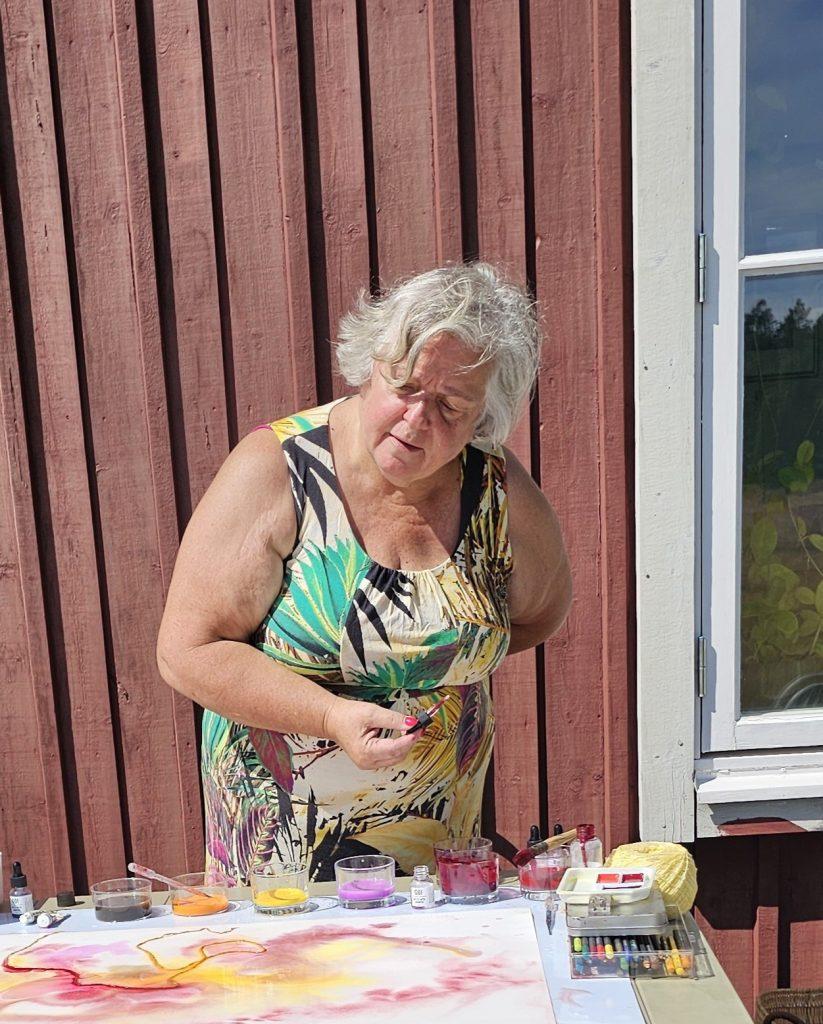
Halloff’s process depends upon a measured exchange between intention and accident. Pigment moves through damp paper, gathers at edges, and settles into irregular blooms. Stones, threads, and wool may be used as temporary masks, redirecting color and revealing concealed structures when removed. Pencil then interrupts, connects, or intensifies the fluid passages.
Art historically, this method has affinities with Surrealist automatism and process-based abstraction, in which materials produce unforeseen events. It also recalls the biomorphic language of Paul Klee, Joan Miró, and Jean Arp, whose forms hover between organism, sign, and landscape. Halloff does not imitate these precedents; she extends their inquiry into how an image can appear alive without depicting a specific living thing.
Her diluted color also enters into dialogue with lyrical abstraction and stain painting. Color is absorbed into the paper rather than merely placed upon it, while pencil introduces a precise, diagrammatic register. Her distinctive language emerges between atmospheric field and drawn network, spreading wash and deliberate trace.
From Chongqing to Weiz
An important international stage in Halloff’s career was her participation in “Art Without Borders: International Exhibition in Chongqing – Emerging Perspectives,” held at the Hongyi Jiuzhou International Culture and Art Centre from 16 October to 16 November 2025. Organized by Pashmin Art and the Hongyi Jiuzhou International Culture and Art Centre, it presented selected works by Halloff within an international group context in Chongqing.
Her ongoing presentation in “Cogitatio Artium – Wo der Gedanke zu Kunst wird” at Kunsthaus Weiz brings this development into a new European setting. Jointly organized by Pashmin Art Consortia and Kunsthaus Weiz, the exhibition opened on Thursday, 24 September 2026, at 19:30 and continues until 7 November 2026. Its title, meaning “Cogitatio Artium – Wo der Gedanke zu Kunst wird,” (“Cogitatio Artium – where thought becomes art”) suits a practice in which ideas emerge through material action rather than preceding it as a fixed programme.
Figures at the Edge of Abstraction
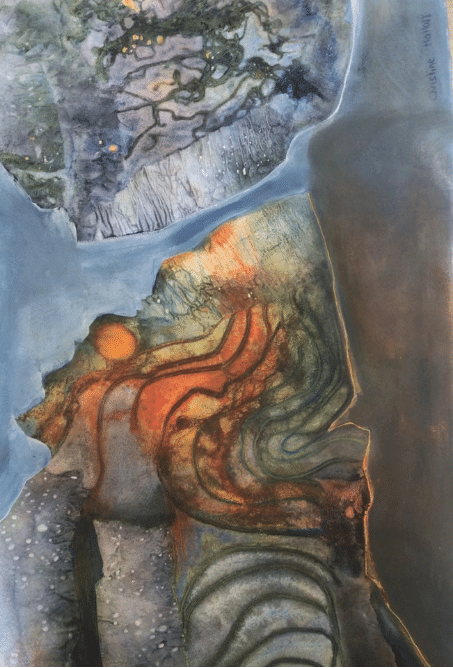
The works from 2021 retain the strongest connection to the human figure. In “You and Me,” a profile-like form rises through greys, blues, greens, and incandescent orange. The image recalls Symbolist and Expressionist figures, in which bodily identity carries psychological meaning. Yet Halloff avoids narrative certainty. The apparent head may contain two presences, an internal double, or a fusion of figure and landscape. The title establishes relationship while keeping its emotional meaning open.
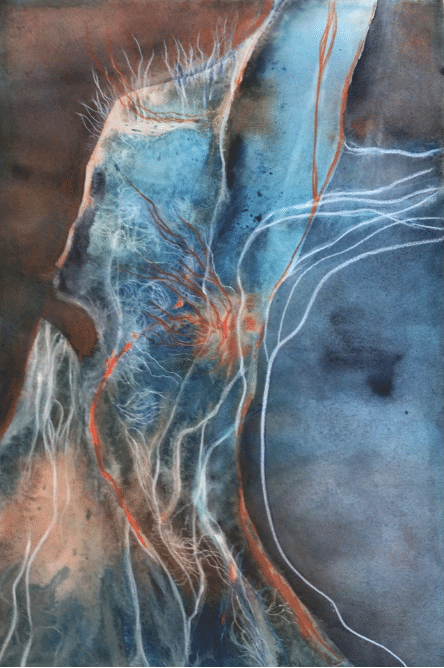
“Limitless 11” is structured by luminous branching lines crossing a deep blue field. The composition can be read as neural anatomy, roots, river deltas, or electrical pathways. It recalls Klee’s understanding of line as an active force and postwar abstraction’s interest in networks. The image has no stable scale: it appears intimate and bodily, then geographic or cosmic.
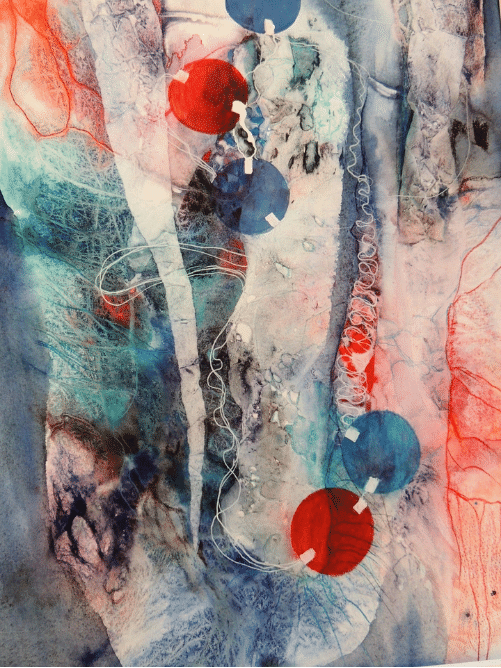
In “He is Walking away,” vertical veils, red circles, and fragmented color replace conventional perspective. The discs act as chromatic punctuation while suggesting distance, memory, or interruption. The painting belongs to lyrical abstraction, where emotion is communicated through rhythm and color rather than descriptive narrative. Departure is not illustrated; it is made perceptible as dispersal.
The “Movement” Series: Stain, Field, and Process
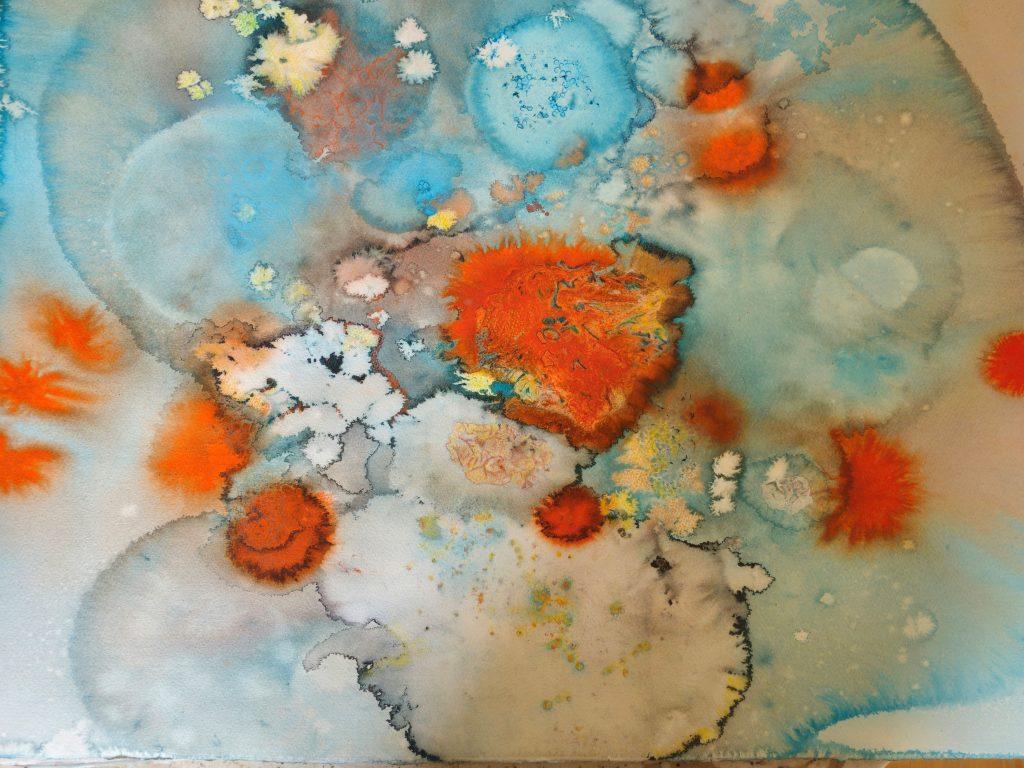
The four works of the 2025 “Movement” series shift toward a larger horizontal field and a more elemental language. In “Movement 1,” orange-red concentrations float within pale blue and grey washes. They suggest cells, spores, blossoms, or eruptions. The circular forms recall both microscopy and cosmic imagery, bringing the infinitely small and the infinitely large into one field.
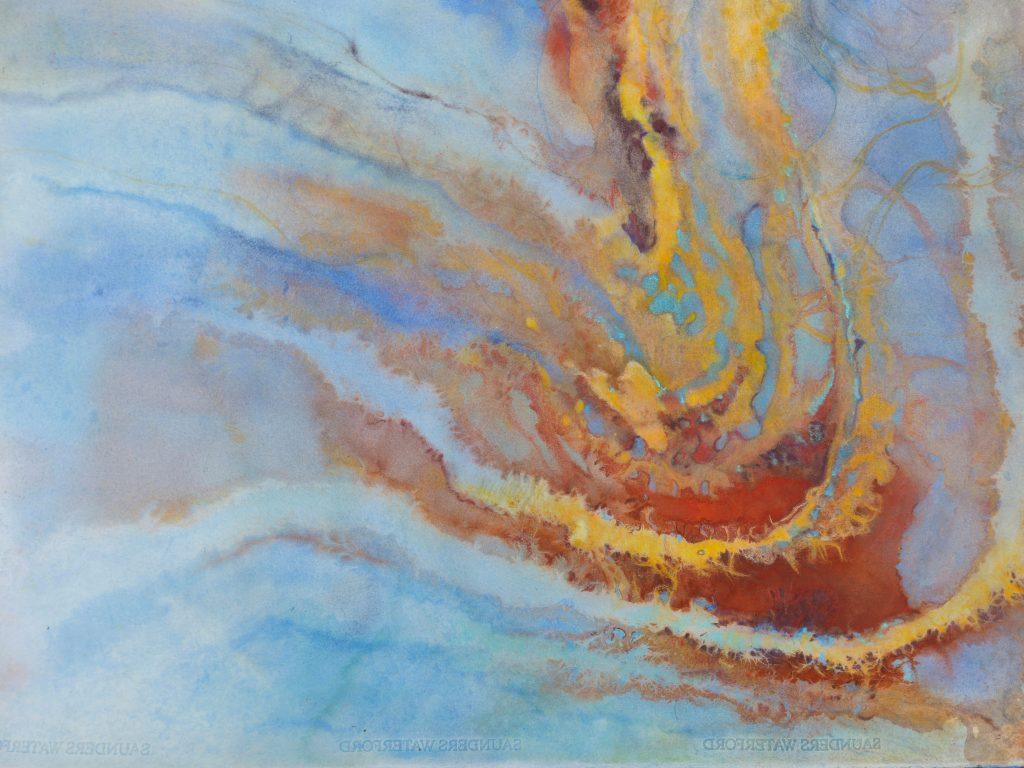
“Movement 2” develops around a sweeping vortex. Pale bands curve toward a dense orange and ochre centre, evoking a whirlpool, geological fold, or atmospheric disturbance. Halloff turns the wash into a record of directional energy: the work is less an image of movement than a surface visibly formed by movement.
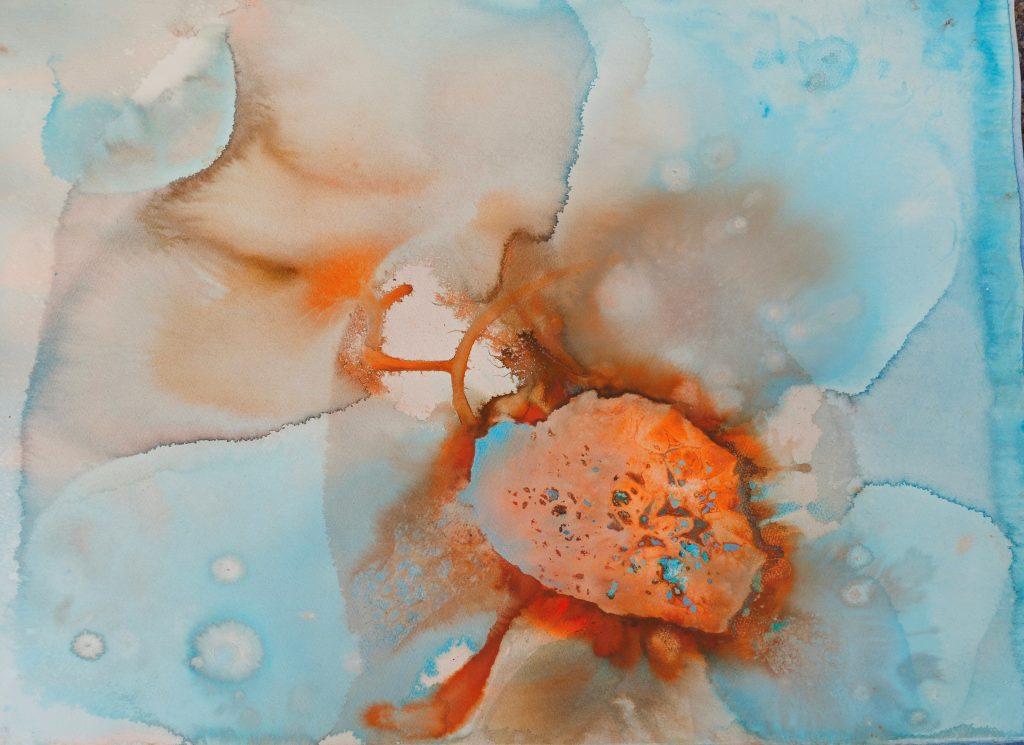
“Movement 3” is quieter and more concentrated. A warm, porous centre appears suspended in a cool field, resembling a seed, flower, cell, or island. Radiating lines connect nucleus and surrounding space. The composition recalls biomorphic modernism, while its soft diffusion gives it the stillness of contemporary organic abstraction.
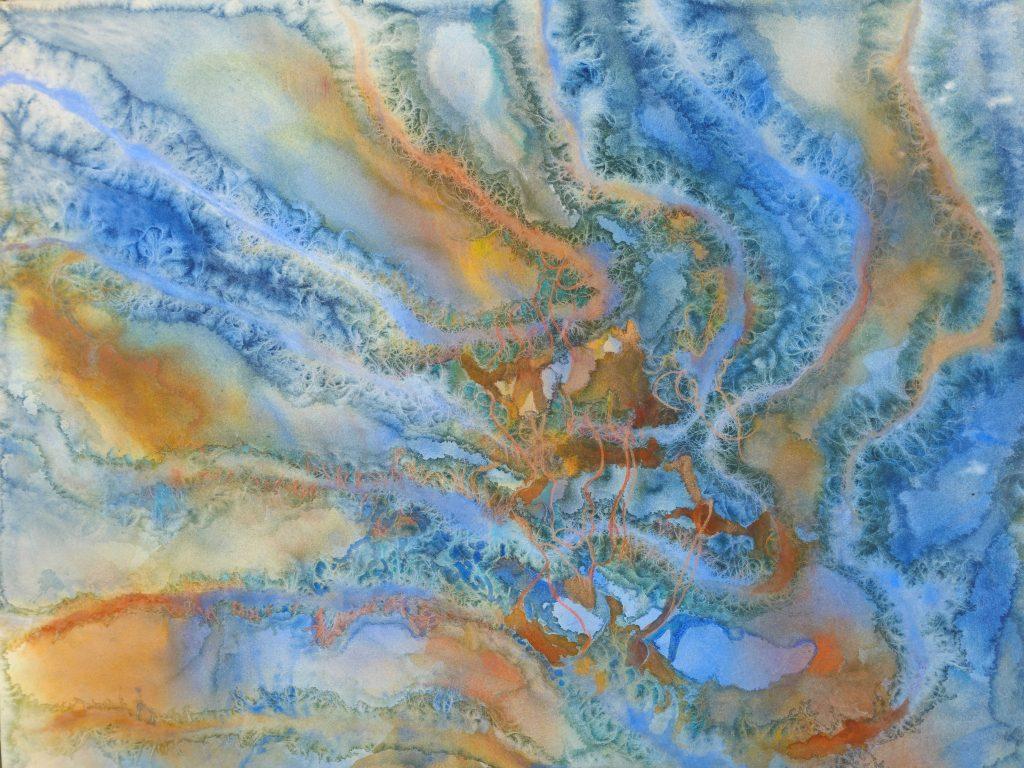
“Movement 4” is the most expansive and all-over work in the group. Blue, ochre, and orange passages form layered currents with no dominant centre. The eye travels through the image as it might follow sediment, mineral veins, or currents from above. The work approaches the field structure of Abstract Expressionism, yet its transparent layering remains distinctly rooted in watercolor.
Where Thought Becomes Form
Across these works, Halloff transforms watercolor from a descriptive technique into a method of inquiry. She joins its history of transparency and observation to modernist traditions of automatism, biomorphism, staining, and process. Her paintings neither surrender entirely to chance nor force material into obedience; they are built through attentive negotiation.
At Kunsthaus Weiz, the dialogue between the 2021 works and the later “Movement” series will reveal an artist moving from psychologically charged, figure-adjacent abstraction toward broader fields of organic transformation. Halloff makes material process visible without reducing the work to technique. Pigment becomes structure, line becomes a living network, and abstraction becomes a means of thinking through nature, memory, and change.
Dr. Davood Khazaie
(Literary Art Critic and International Curator)
© The copyright of the text belongs to Dr. Davood Khazaie
Find out more at the Weiz Website