A Life Shaped by Transformation
Sonia Parchet’s art is rooted in a biography marked by movement, reinvention, and attention to the inner life. Born in France, raised in Germany, and now based in Switzerland, she worked across acting, directing, circus training, coaching, and complementary therapy before committing herself fully to painting. These fields required discipline, empathy, and responsiveness to others—qualities that continue to shape her visual practice.
Her decision to pursue painting professionally in 2023 brought these experiences together. Performance informed her sense of rhythm and presence; therapeutic work deepened her interest in transformation; and family life, including her role as a mother of three, strengthened her awareness of care, inheritance, and connection.
An Expanding Exhibition History
Parchet made her public exhibition debut at “Swissartexpo” in Zurich in 2024. Her collaboration with Pashmin Art soon became central to her international development. In 2025, “Visions in Color and Spirit” at Pashmin Art Gallery in Hamburg placed her soul mandalas in dialogue with works by Maj-Britt Niklasson and Alessandro Cardamone.
The collaboration then extended into museum contexts. At the Hong Art Museum in Chongqing, Parchet participated in “Fusion of Horizons: Contemporary Art in Dialogue,” which examined relationships between contemporary practice, cultural heritage, and Eastern and Western perspectives. At the Rothko Museum in Daugavpils, “Tensions and Transitions: Navigating the Boundaries of Being” included “Healing” and “Golden Age Web,” placing her work within a broader reflection on identity, psychological change, and spiritual searching. In 2026, she was also represented in “Muses of Modernity: Women Artists Inspiring Change” at the Kunsthaus/Stadtgalerie Weiz.
The Soul Mandala
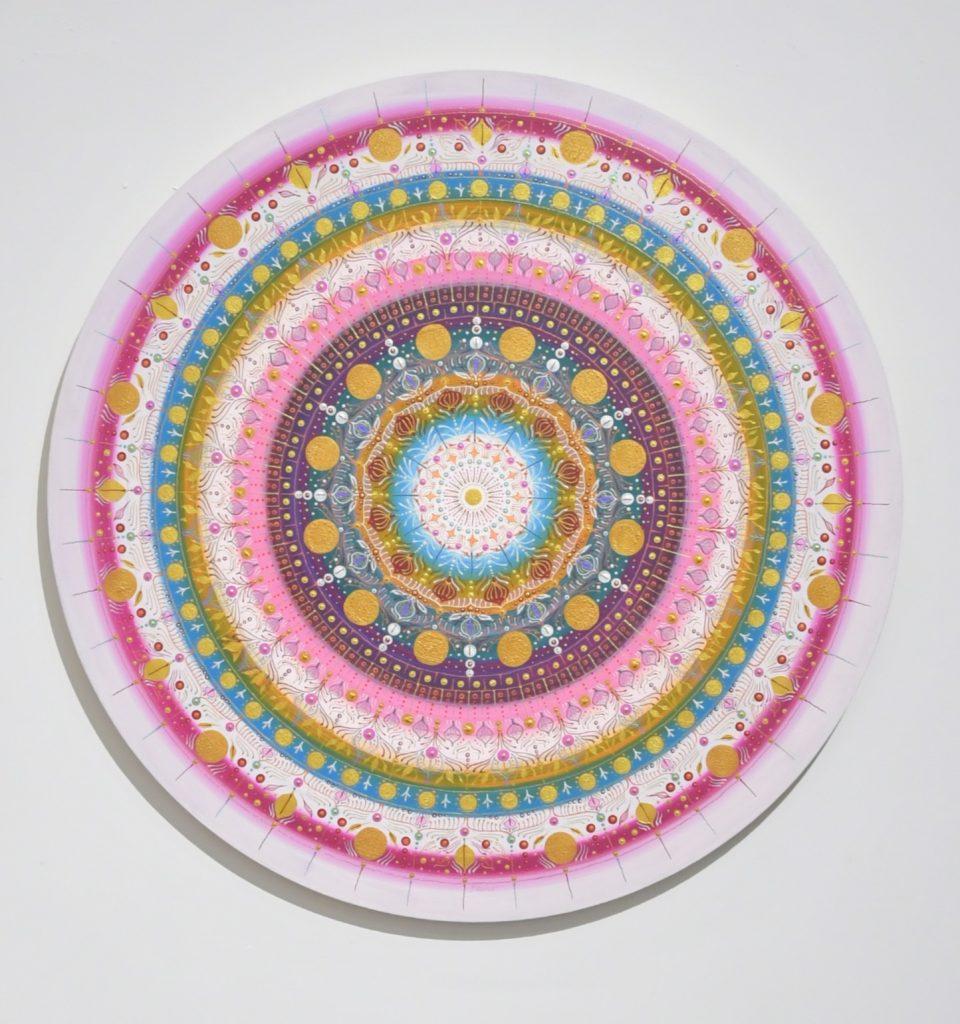
At the centre of Parchet’s practice is the soul mandala. She treats the mandala not simply as an ornamental or geometrical form, but as a language through which emotional, spiritual, and biographical experience can become visible. Her commissioned works often begin with a personal conversation. She then develops the painting intuitively, seeking to evoke the subject’s inner character rather than reproduce physical appearance.
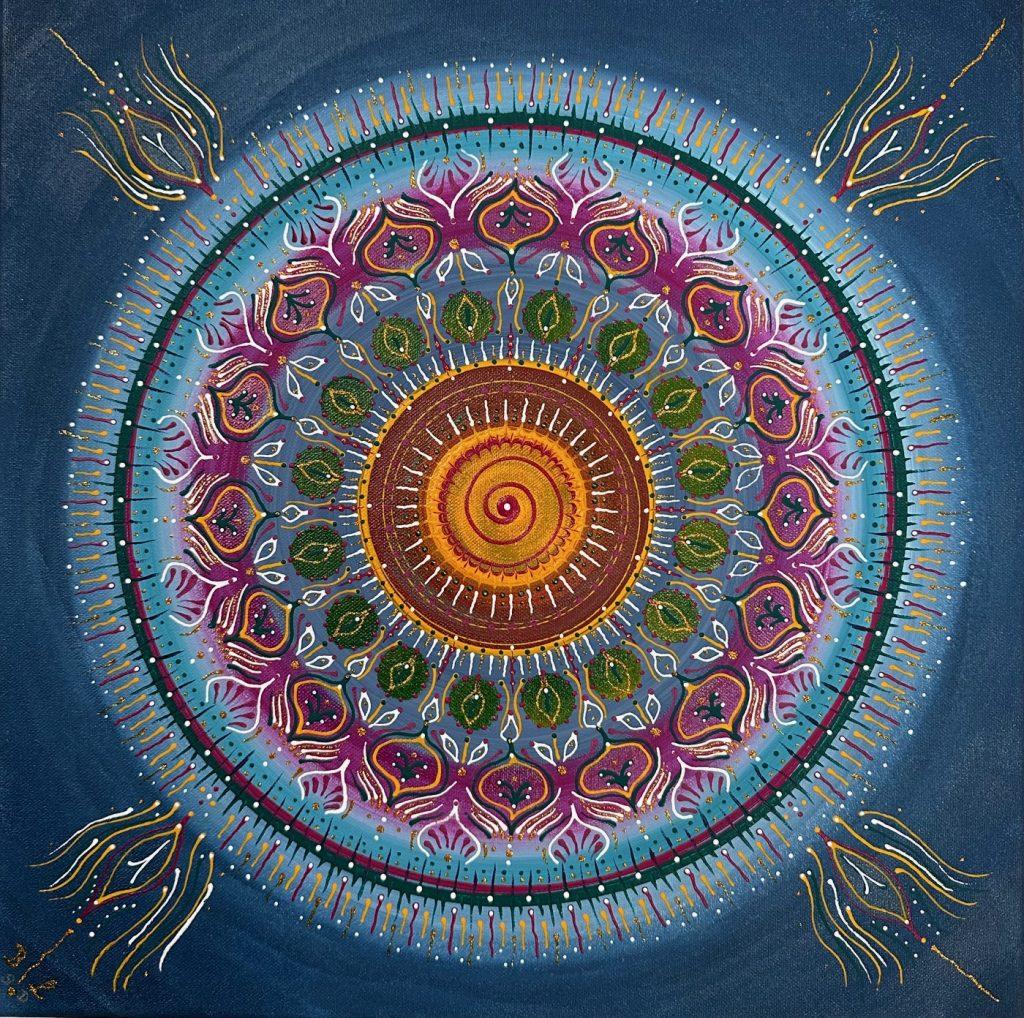
Her compositions grow through concentric rings, dots, petals, radiating lines, ornament, and modulated colour. Their symmetry creates balance, yet subtle variations preserve the trace of the artist’s hand. The circle may suggest a flower, womb, sun, eye, cell, clock, portal, or universe. Because these meanings remain fluid, the paintings invite viewers to contribute their own memories and associations.
Memory, Identity, and Human Connection
The works selected for “Landscapes of the Soul” (“Seelenlandschaften”), to be presented at the Museums of the Castle and Residential City of Greiz by Pashmin Art Consortia from 3 October to 22 November 2026, trace Parchet’s development between 2020 and 2025.
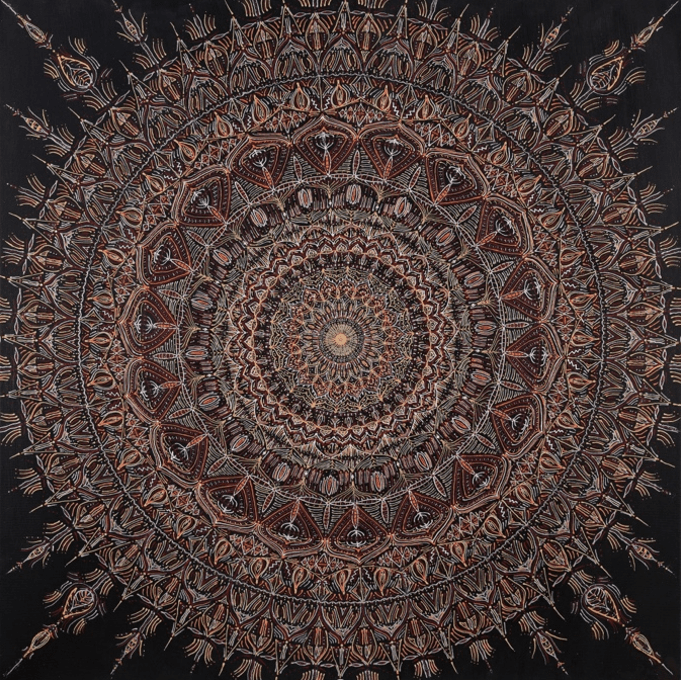
The early works “Heritage” and “Creativity” establish the personal foundations of her language. “Heritage” transforms the layered circle into an image of transmission, suggesting generations and memories developing from a shared centre. Darker and denser, “Creativity” presents creative energy as something brought forth from accumulated experience through concentration.
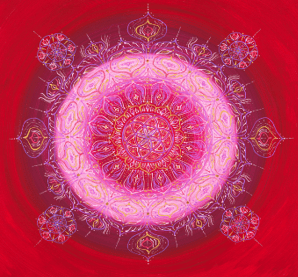
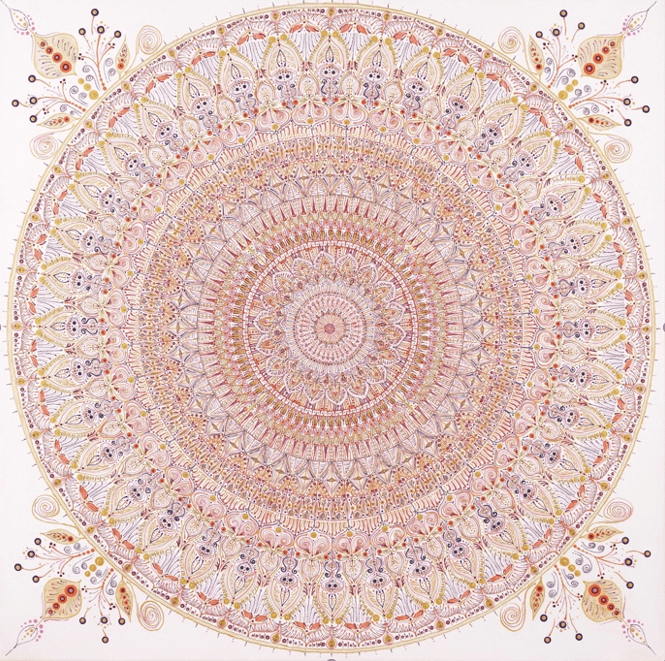
In “Motherhood,” a luminous pink and violet centre expands across an intense red ground. The composition evokes a womb, heartbeat, flower, and protective enclosure, giving form to origin, care, and emotional continuity. “Love,” by contrast, is pale and almost weightless. Its rose, cream, and gold-toned structure dissolves into the surrounding field, presenting love as a quiet atmosphere of relation.
Geometry, Time, and Illumination
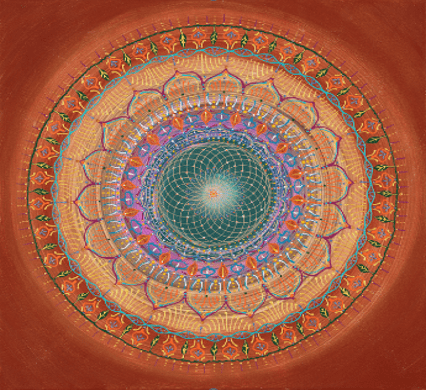
Parchet’s works from 2023 place greater emphasis on structure, time, and light. In “Geometry,” green, blue, orange, and terracotta rings gather around a deep optical centre. Although carefully ordered, the form appears organic, as though breathing or flowering.
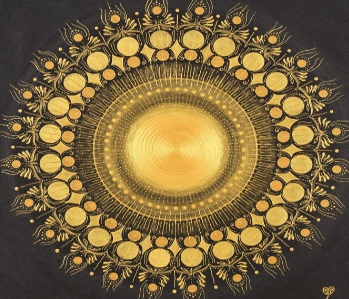
“Time Break” sets a dense pink and violet mandala against an acidic yellow-green field. The contrast may suggest a pause from chronological pressure or a rupture through which another experience of duration becomes possible. “Beau Line,” meanwhile, introduces a radiant golden centre against black. Recalling a sun, ceremonial object, or sacred diagram, it connects the drawn line with a path of spiritual orientation and illumination.
From the Mandala to the Cosmos
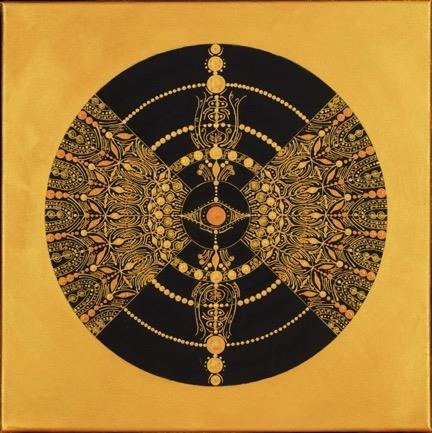
The works of 2024 broaden Parchet’s visual vocabulary. In “Golden Age Web,” a black circular field is crossed by golden networks and a vertical axis, suggesting links between matter and spirit, the individual and the universe. “Splendid” is more open and delicate, using white, cream, ochre, gold, and black to create a lace-like structure whose radiance depends as much on restraint as on ornament.
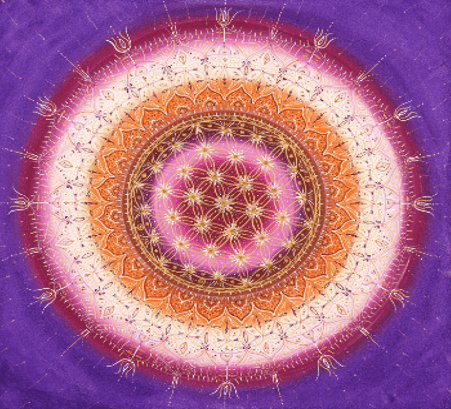
“Blume des Lebens” (“Flower of Life”) unfolds through violet, magenta, orange, and white, resembling a flower, cell, and cosmos at once. In “Happiness,” painted on a circular canvas, support and mandala become one; brightly coloured rings and open intervals create a sense of movement and celebration.
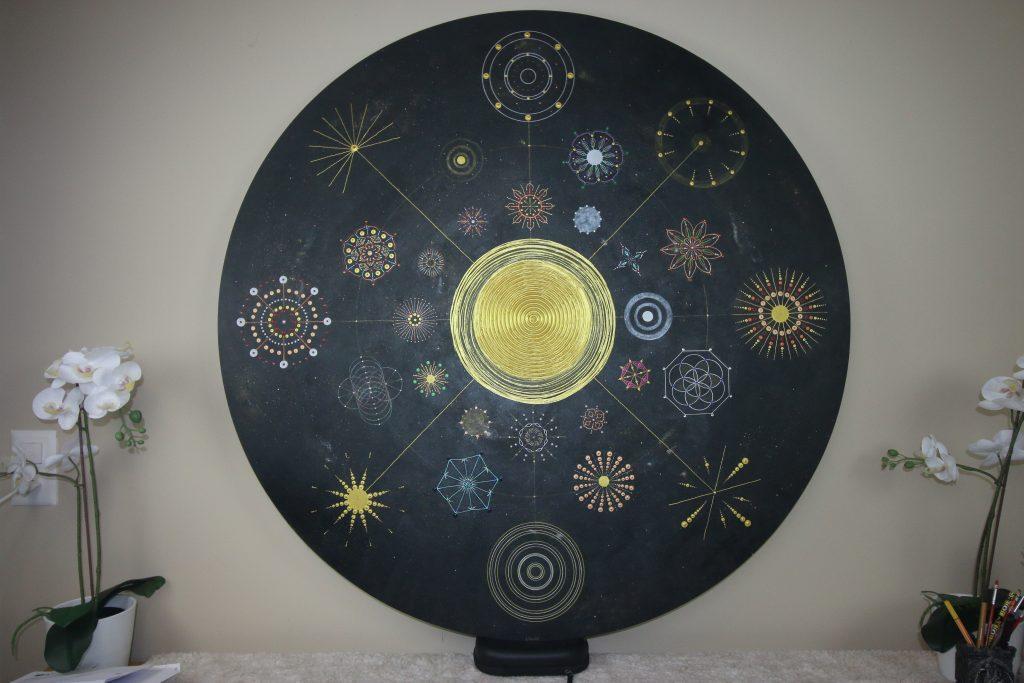
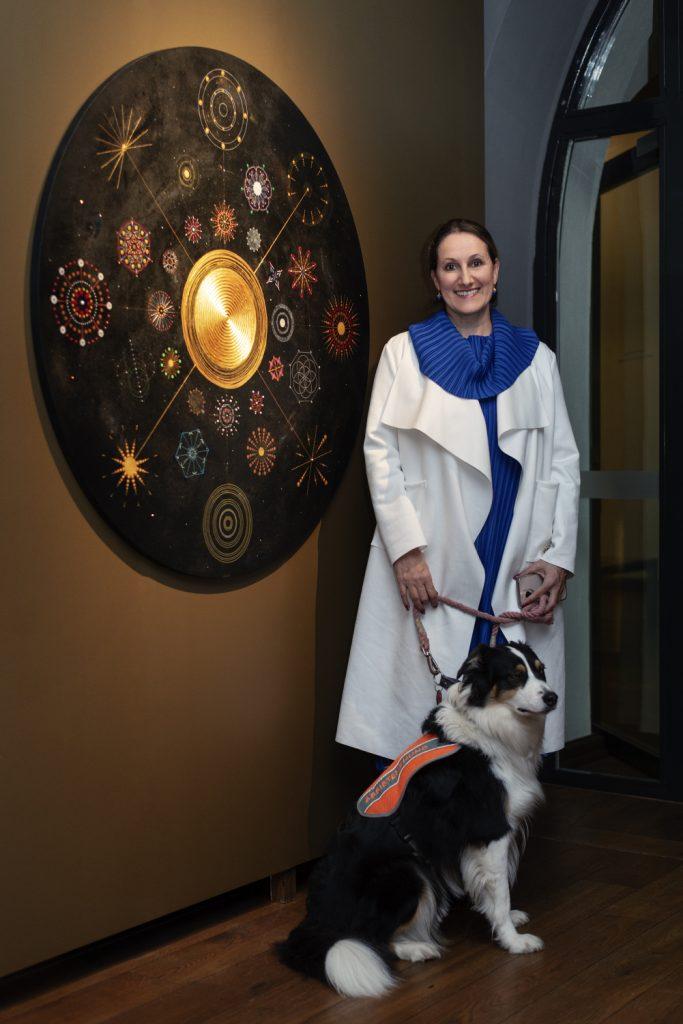
The culmination of this development is “Universal Strings” from 2025, painted on a circular wooden support measuring 120 centimetres in diameter. A large golden disc anchors the dark surface. Its hand-drawn rings create the sensation of vibration, while orbital diagrams, flowers, starbursts, concentric circles, and geometric constellations surround it. Fine golden lines connect several forms to the centre.
The “strings” of the title make invisible relationships visible. Each motif has its own identity and internal order, yet belongs to a larger system. Parchet opens the traditional mandala: one dominant body is accompanied by multiple secondary centres. The work moves beyond individual balance toward a cosmology of interdependence, presenting the universe as a living network of distinct yet connected forms.
“Landscapes of the Soul” in Greiz
The forthcoming exhibition “Landscapes of the Soul” offers a meaningful context for Parchet’s paintings. The historic castle environment preserves layers of architecture, memory, and cultural identity, while her mandalas are built through accumulated rings, repeated marks, symbolic centres, and visual thresholds. In Greiz, the works can be understood as contemporary architectures of memory.
The title is especially apt because Parchet does not depict external scenery; she maps inner states. “Heritage” and “Motherhood” address identity, family, and transmission. “Time Break” explores changing experiences of duration. “Beau Line” and “Golden Age Web” transform darkness into illumination, while “Universal Strings” expands the personal centre into a network of cosmic relationships.
Together, the selected works move from intimate portraiture and emotional memory to spiritual diagram and universal constellation. They lead from the personal centre toward a shared universe. Parchet’s art proposes that identity is neither isolated nor fixed, but formed through layers of experience and through relationships with other people, inherited histories, and the wider world. In her paintings, harmony arises from the living connection of distinct forms.
© The copyright of the text belongs to Dr. Davood Khazaie
Website Sonia Parchet