On perception, identity, and the transformation of the photographic image
In the art of Lionel Machris, the human face becomes a mysterious territory where appearance and identity, material and light, permanence and fragility intersect. Emerging from luminous surfaces of pure gold, his portraits seem simultaneously present and elusive, revealing themselves gradually while resisting complete recognition. Their delicate features, fragmented textures, and shifting reflections invite viewers into an encounter that extends beyond conventional portraiture. Machris does not merely reproduce the human face; he transforms it into a field of psychological and philosophical inquiry, where looking becomes inseparable from the uncertainties of perception.
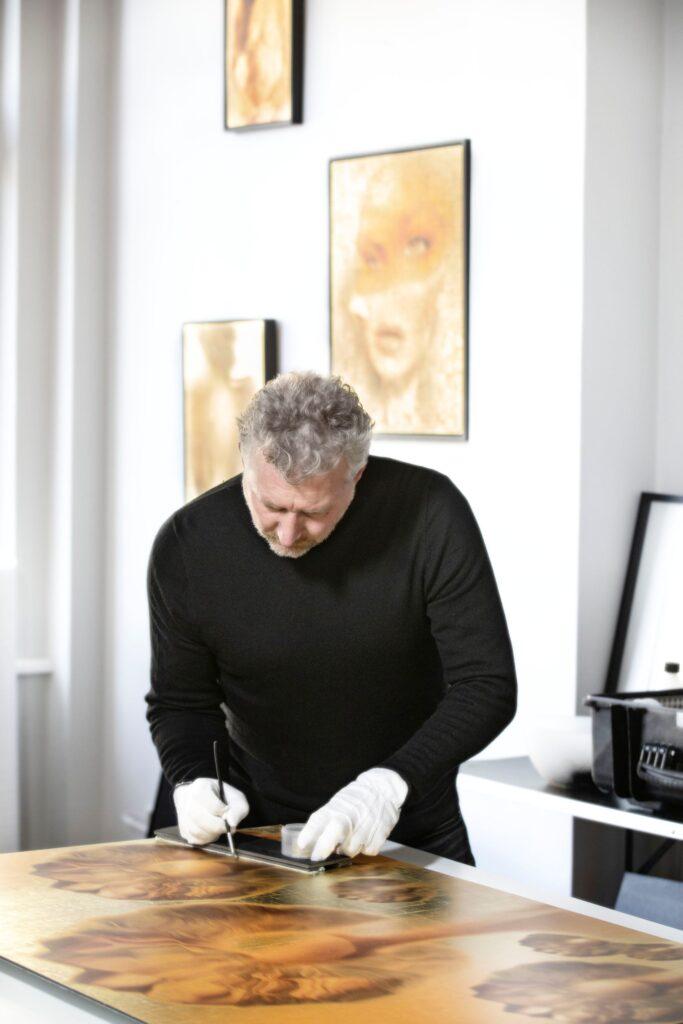
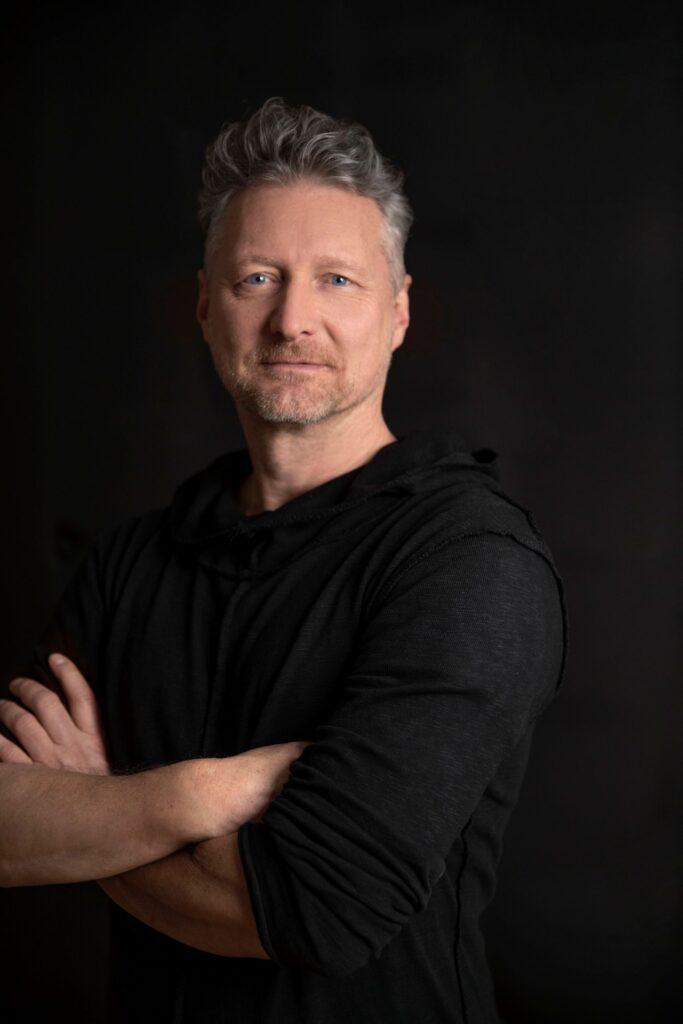
Lionel Machris is a German photographer and visual artist based in Hamburg whose career began in international fashion and editorial photography. After training as a photographer, he attended courses in painting and graphic arts at the Hamburg University of Fine Arts. In 1989, he moved to Paris, where he assisted international fashion and cosmetics photographers, before continuing his career in Milan in 1992. His professional experience includes collaborations with magazines such as Vogue, Elle Germany, and Madame Germany, alongside commissions for prominent international brands. These experiences developed his sensitivity to the expressive possibilities of the face, the orchestration of light, and the relationship between photographic precision and visual suggestion.
His subsequent transition toward fine art transformed these technical foundations into a distinctive artistic language. Machris combines photography, painterly intervention, and printing onto specially prepared 24-carat gold leaf. The resulting works possess a physical presence that cannot be fully reproduced photographically. Their appearance changes according to the position of the viewer and the surrounding light. Gold is therefore not merely a decorative material but an active element in the construction of meaning, alternately revealing and concealing the images it carries. The fragmented, almost mosaic-like surfaces further complicate perception, allowing recognizable faces to appear simultaneously continuous and unstable.
Four works by Machris were presented in Seelenlandschaften, the international exhibition of contemporary art held from 4 October to 22 November 2026 at the Museums in the Castle Town and Royal Capital of Greiz. Presented in collaboration with Pashmin Art Consortia, the exhibition explored the relationship between external appearances and inner experience. Within this context, Machris’s portraits offered a particularly compelling interpretation of its central theme: the human face itself becomes a landscape of memory, emotion, and perception.
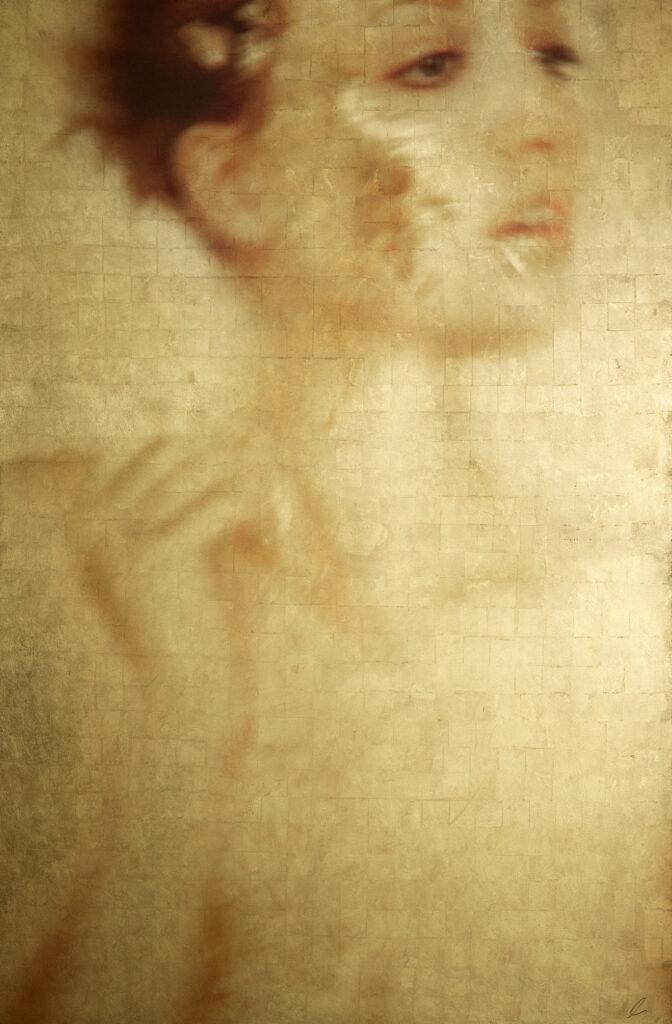
In The Resolute (2022), a softly illuminated female figure emerges from a golden surface composed of delicate, irregular rectangular fragments. Her face turns away from the viewer, suggesting concentration upon something beyond the pictorial space. The contours of her body gradually dissolve into the surrounding gold, while subtle traces of movement interrupt the apparent stillness. Although the title suggests determination, the image avoids conventional expressions of strength or assertiveness. Instead, resolution appears as a quiet internal condition. The figure’s partial disappearance into the luminous surface introduces an ambiguity between vulnerability and self-possession. The work suggests that determination may reside not simply in outward gestures but in an inward state of composure, sustained even amid uncertainty.
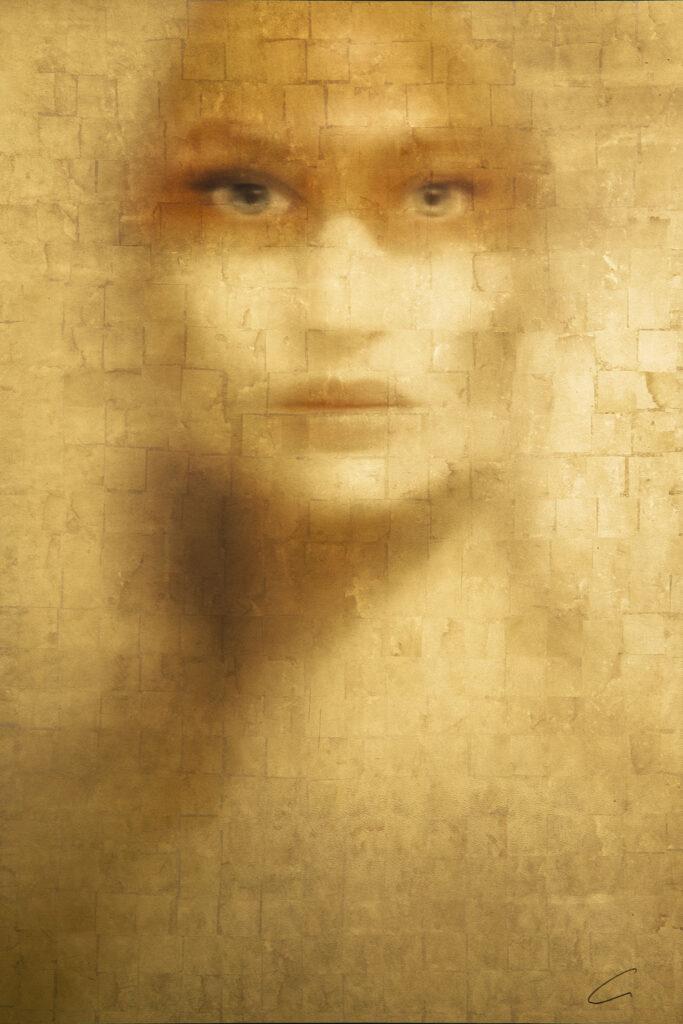
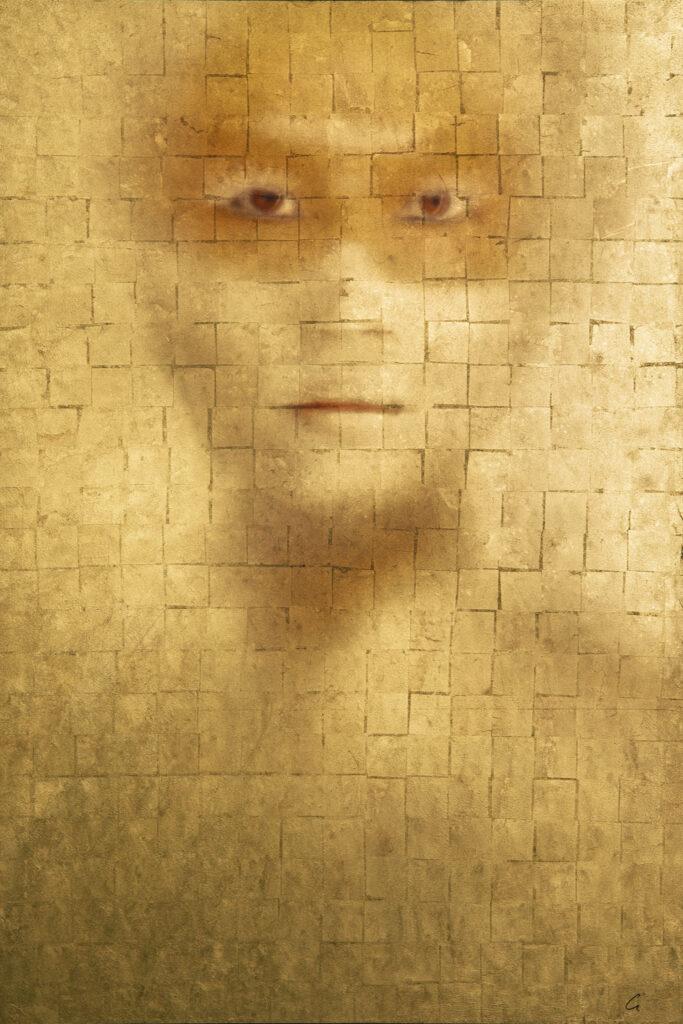
Prudentia (2019) introduces a more contemplative encounter. A face confronts the viewer through an intricate arrangement of golden fragments, its eyes emerging with remarkable intensity from the surrounding surface. The portrait possesses an almost architectural structure, as though the image had been assembled from numerous individual pieces. Its restrained expression suggests watchfulness rather than certainty. Associated with the classical tradition of moral virtues, the work invites reflection on judgment, awareness, and the responsibilities of perception. The fragmented surface reinforces this interpretation: perception is constructed from partial information, and understanding requires the careful negotiation of what remains incomplete. The direct gaze establishes an intimate relationship with the viewer, who becomes both observer and subject of scrutiny.
A related but distinctly different emotional atmosphere characterizes Spes (2019). The softly rendered face appears almost suspended within the golden field, its features emerging through delicate transitions of light and shadow. Compared with the concentrated intensity of Prudentia, the expression feels more open and vulnerable. The figure seems to exist between visibility and disappearance, suggesting hope as something fragile yet enduring. Rather than illustrating an abstract ideal through conventional allegorical symbols, Machris allows the quality of the image itself to communicate the idea. The gradual emergence of the face from the gold can be read as a visual metaphor for possibility, persistence, and the human capacity to imagine a future beyond immediate circumstances.
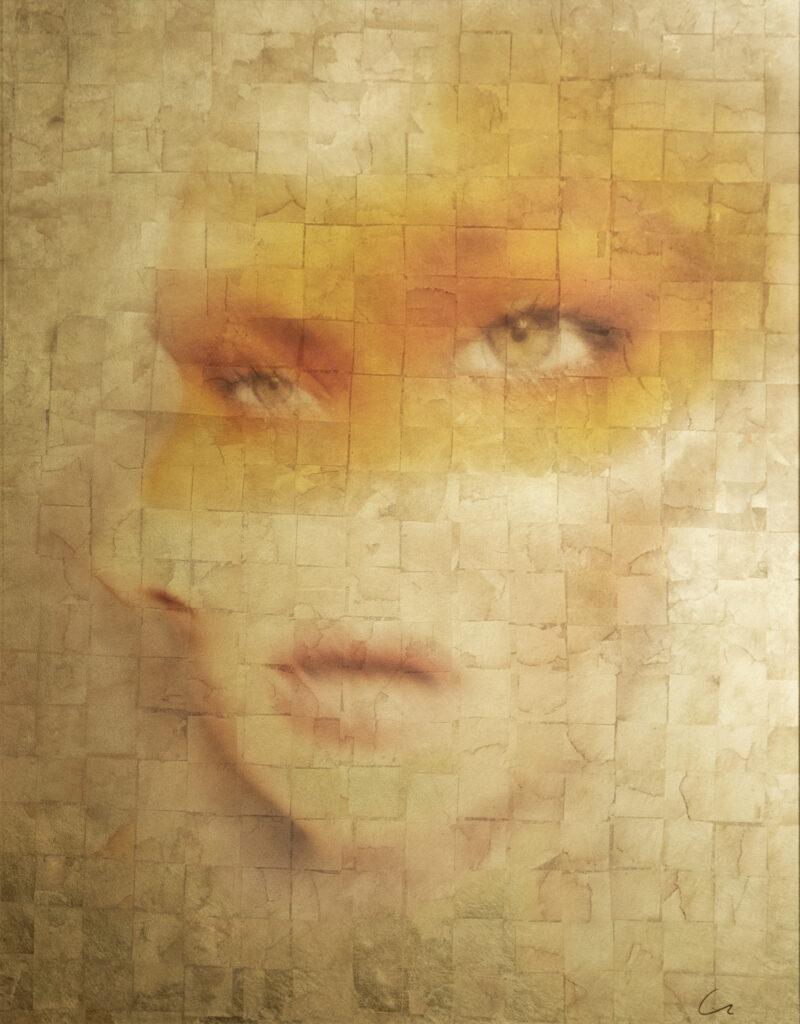
In Mme Perplexe Illusion Part II (2021), the relationship between image and perception becomes considerably more complex. Two faces overlap within the same composition, their features merging and separating across the fragmented golden surface. The eyes, facial contours, and subtle variations of expression suggest different presences occupying a shared pictorial space. At first, the viewer may attempt to recognize a single coherent portrait, only to discover another face emerging through it. The two images do not simply coexist; they interfere with and transform one another, creating a visual experience in which identity becomes fluid and uncertain. This superimposition is central to the work’s psychological significance. The faces may be understood as different perspectives, emotional states, or dimensions of identity, although the composition deliberately avoids fixing their relationship. Their coexistence raises questions about the complexity of self-perception and the difficulty of distinguishing appearance from reality. The reflective gold intensifies the ambiguity, causing certain features to emerge while others recede according to illumination and viewpoint. The image seems to change as one looks at it, suggesting that identity is not necessarily a stable, singular presence but something continually reconstructed through memory, experience, and observation. Among the four exhibited works, Mme Perplexe Illusion Part II most explicitly challenges the assumption that a portrait must represent one person through one unified image.
Considered together, these four works establish a subtle dialogue between ethical values, emotional states, and the instability of perception. The Resolute suggests determination, Prudentia thoughtful judgment, Spes hope, and Mme Perplexe Illusion Part II the complexity of identity and perception. Yet these qualities are never presented as fixed psychological definitions. They emerge through facial expression, photographic treatment, fragmented surfaces, and changing illumination. The recurring gold recalls the luminous backgrounds of historical religious icons, but Machris reinterprets this visual tradition through contemporary photographic processes. Where gold once frequently signified sacred transcendence, it now becomes a medium through which the complexity of human existence can be explored.
Machris’s international exhibition history, extending from European art venues to presentations in China and the United States, reflects the growing reach of this artistic language. His participation in exhibitions at the Hong Art Museum in Chongqing, the Rothko Museum, and the 2025 Hamburg–Shanghai anniversary exhibition further situates his practice within a dialogue between different cultural contexts.
At Greiz, his four golden portraits offered an intimate counterpoint to the exhibition’s broader exploration of inner landscapes. They suggest that the most complex territories are not necessarily geographical but human: the changing expressions of a face, the uncertainties of thought, and the fragile relationship between what is revealed and what remains hidden. Through the meeting of photography, precious material, and psychological suggestion, Lionel Machris creates images that do not merely ask to be seen. They ask us to reconsider what seeing means.
© The copyright of the text belongs to Dr. Davood Khazaie