On the emotional life of landscape, the ambiguity of realism, and six paintings exhibited at Museums in the Castle Town and Royal Capital of Greiz
At first glance, the paintings of Holger Dempwolff appear to offer recognizable worlds: snow-covered mountains, quiet lakes, expansive skies, and people gathered in familiar surroundings. Yet beneath their meticulously rendered surfaces, something more elusive begins to emerge. Light and shadow establish unexpected relationships, landscapes acquire an almost psychological presence, and ordinary scenes suggest realities extending beyond what can immediately be seen. Dempwolff’s art inhabits this delicate threshold between observation and imagination, where beauty is neither innocent nor necessarily reassuring, and where the visible world becomes a reflection of inner experience.
Born in Göttingen, Germany, in 1958 and raised in Munich, Dempwolff grew up in an environment shaped by artistic creativity. His father was a film composer, his mother worked in cinema, and his grandfather was a painter who introduced him to watercolor painting during excursions into the Bavarian countryside. These early encounters taught him to observe water, clouds, and natural light with unusual attentiveness. Having completed his artistic studies in Basel in 1984, he now lives and works between the Swiss Jura near Biel and southern France. His artistic influences include Johannes Vermeer, Salvador Dalí, and Caspar David Friedrich, whose respective interests in luminous precision, imaginative transformation, and the spiritual dimension of landscape resonate throughout his work.
Dempwolff describes his approach as “quiet, figurative painting.” His compositions frequently originate in photographic references, sketches, and memories, which he combines into carefully constructed scenes. Through successive layers of paint, he develops an extraordinary degree of detail while maintaining the balance of the overall composition. Yet technical precision is never merely an exercise in representation. It allows the artist to give convincing form to situations in which reality and imagination subtly intersect.
This artistic language found a particularly meaningful setting in Seelenlandschaften (Landscapes of the Soul), the international exhibition of contemporary art presented from 3 October to 22 November 2026 at the Museums in the Castle Town and Royal Capital of Greiz. Presented in collaboration with Pashmin Art Consortia, the exhibition brought Dempwolff’s work into a context where landscape could be understood not simply as geographical scenery but as a carrier of memory, emotion, and psychological reflection. His six exhibited paintings reveal different dimensions of this relationship.
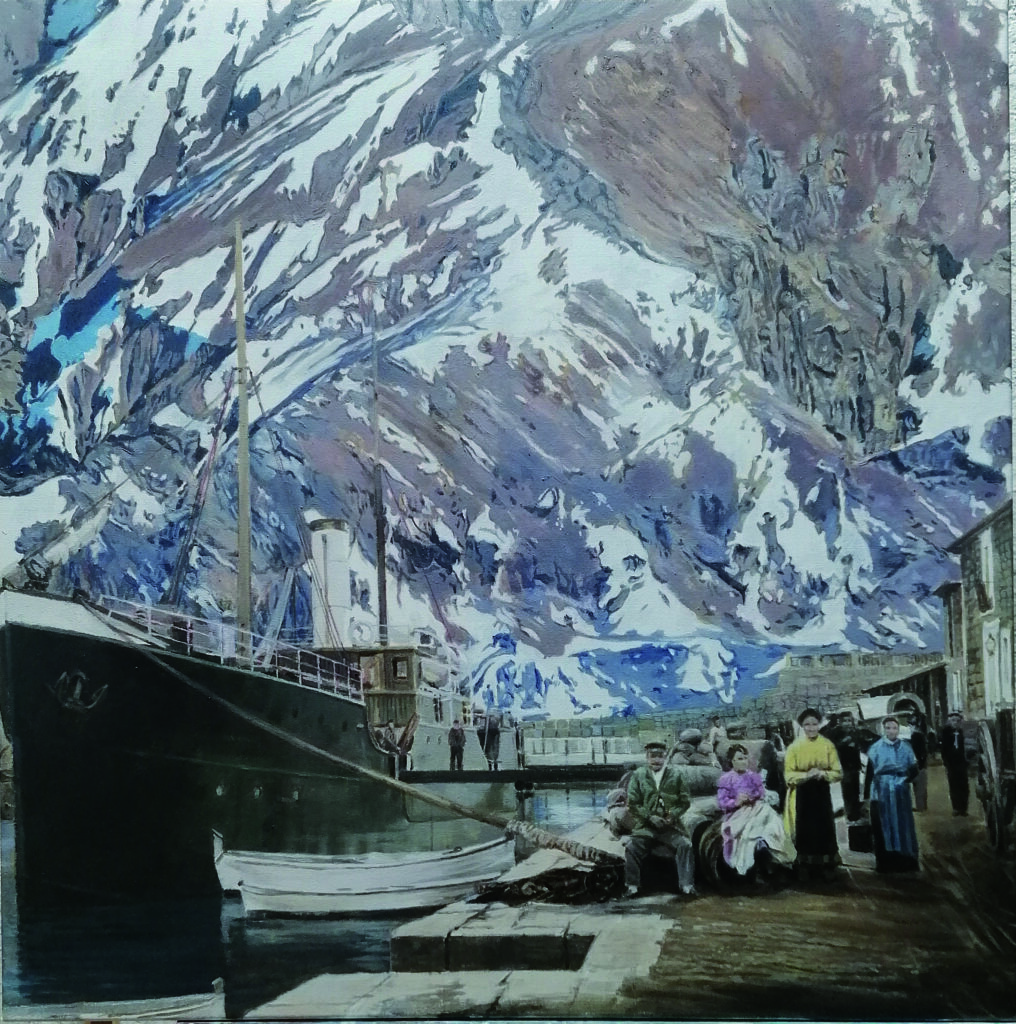
In Le Départ (The Departure, 2025), a harbor scene unfolds beneath an immense wall of snow-covered mountains. A large vessel occupies the foreground, while small figures in historical-looking clothing gather along the waterfront. The architecture, clothing, and maritime details evoke a past era, yet the towering mountains appear almost disproportionately close, creating a remarkable tension between the familiar and the improbable. The composition suggests a meeting of different geographical and temporal realities, as though fragments of memory had been assembled into a single imagined place. The title introduces the idea of departure, an act associated with anticipation, uncertainty, and transformation. Against the overwhelming permanence of the mountains, human movement appears both purposeful and fragile.
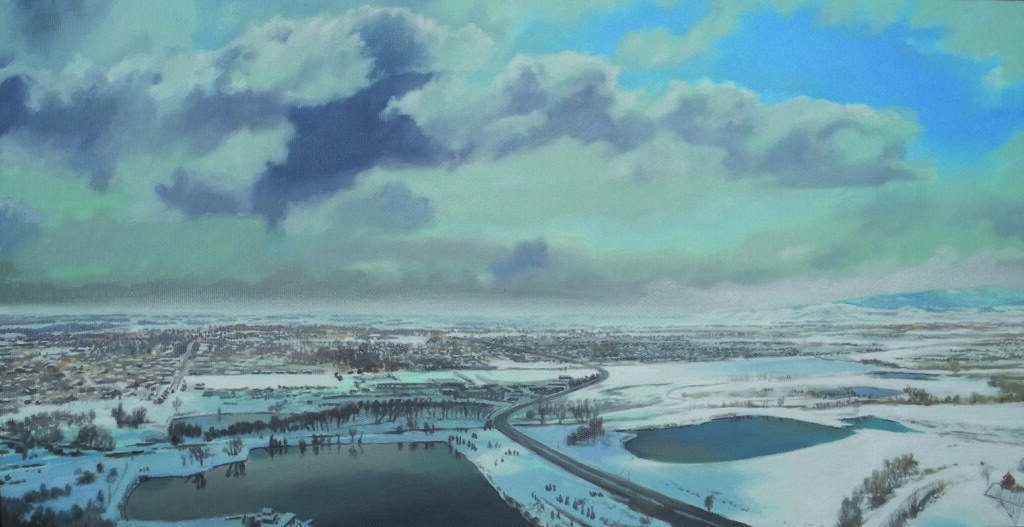
A different sensibility emerges in Winterlandschaft (Winter Landscape, 2018). Here, the viewer encounters a vast, snow-covered plain stretching beneath an expansive, cloud-filled sky. Dark pools of water interrupt the white terrain, while a winding road crosses the landscape toward the distant horizon. The painting’s elevated viewpoint creates an extraordinary sense of openness, allowing the eye to travel across subtle variations of atmosphere and terrain. Unlike the imposing mountains of Le départ (The Departure), this landscape derives its emotional force from spaciousness and restraint. The road introduces a quiet trace of human activity without disturbing the prevailing silence. Winter becomes not merely a season but a condition of contemplation, suggesting both isolation and the possibility of renewal.
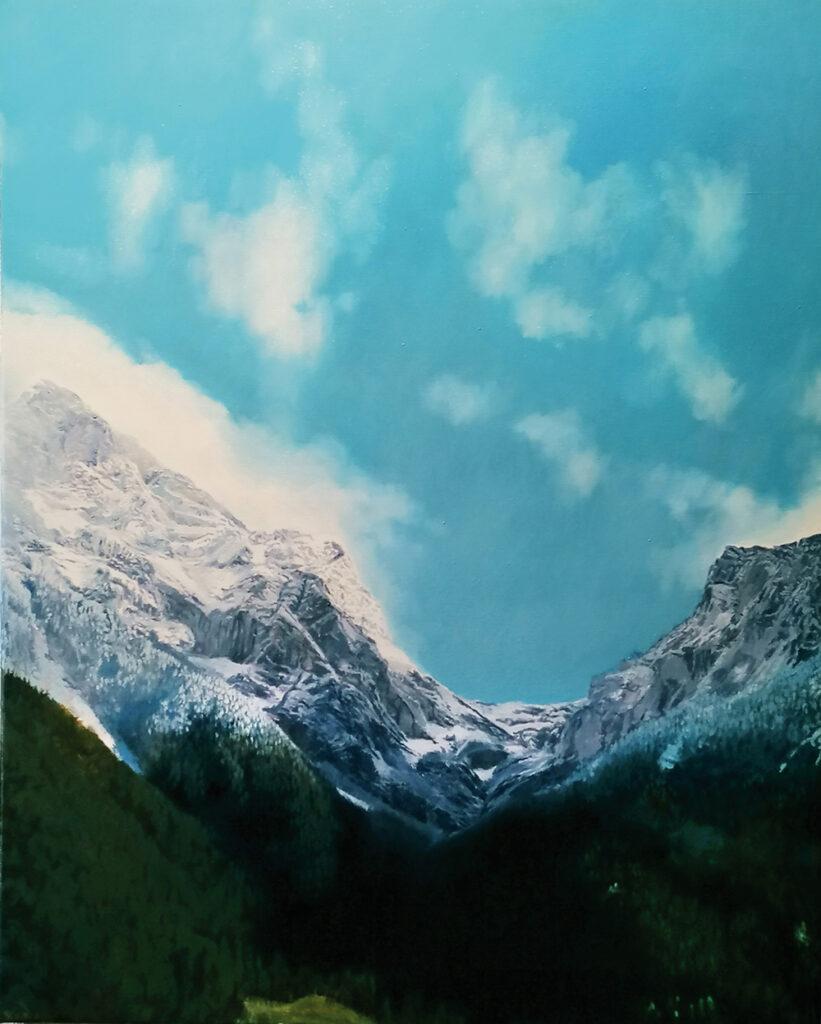
In Dunkles Tal (Dark Valley, 2020), Dempwolff constructs a more concentrated encounter between illumination and obscurity. Brilliant turquoise skies rise above snow-covered mountain peaks, while the lower valley disappears into deep green and almost black shadows. The contrast is striking: the upper landscape possesses a radiant clarity, yet the valley remains inaccessible to the eye. Rather than presenting darkness as an explicit threat, the painting allows it to become an unexplained presence. The viewer is simultaneously attracted by the crystalline beauty of the mountains and drawn toward the concealed depths below. This tension recalls the Romantic fascination with the sublime, particularly the possibility that nature can inspire wonder while remaining fundamentally beyond human comprehension.
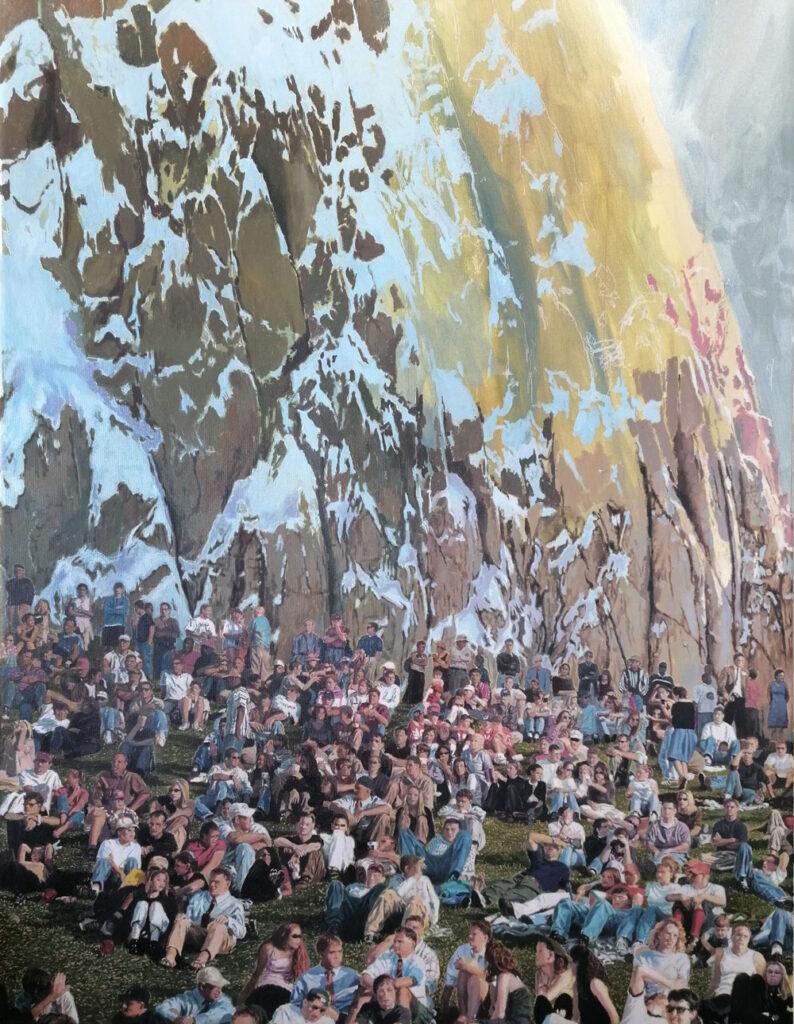
The relationship between human awareness and the surrounding world becomes especially compelling in Le Concert (The Concert, 2026). Hundreds of individually rendered figures occupy the foreground, seated or standing in animated groups before a concert. Behind them rises an immense, snow-covered rock face, dramatically illuminated by a shaft of golden light. The contrast between the crowded social gathering and the monumental landscape produces a powerful visual and psychological disjunction. Dempwolff has explained that the imposing rock formation does not exist in the actual setting but was deliberately introduced into the composition. For him, it suggests how people may continue their conversations and pleasures while remaining unaware of something potentially threatening in the background. Yet the painting resists a fixed interpretation. The golden illumination lends the mountains an almost transcendent quality, while the concentration of human figures creates an atmosphere of vitality and collective experience. Pleasure, beauty, vulnerability, and uncertainty coexist without resolving into a single message. The extraordinary patience required to paint the individual faces further reinforces the artist’s commitment to the complexity of human observation.
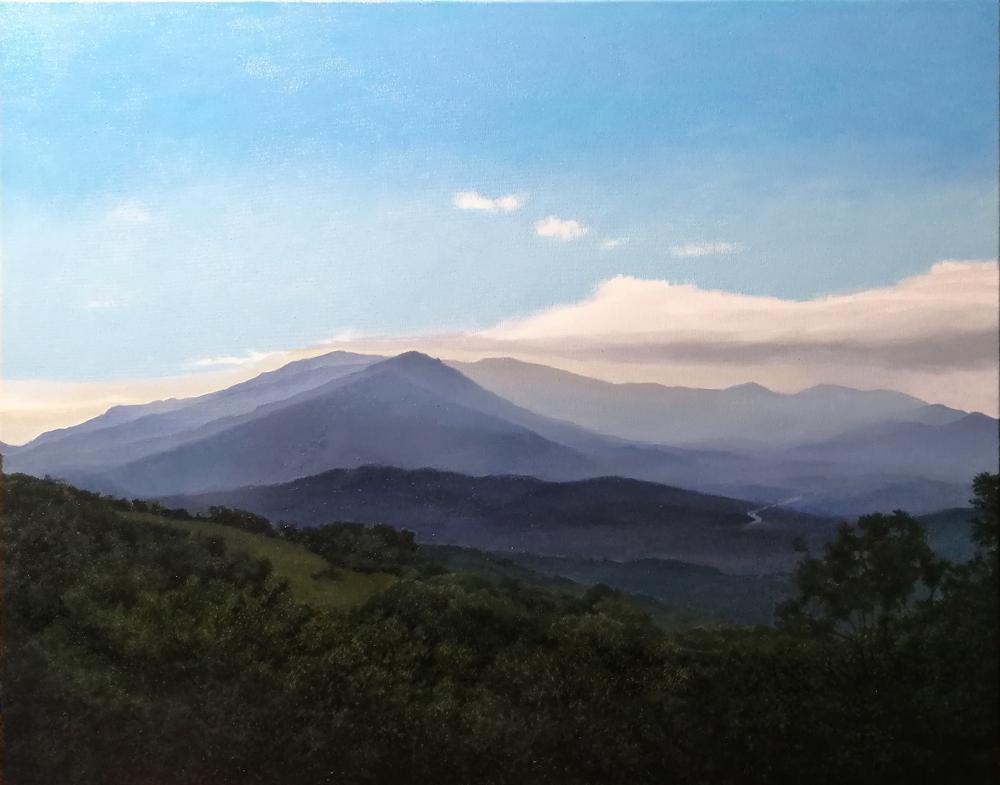
In Light on Earth (2026), the psychological significance of illumination becomes the central subject. A succession of mountain ridges recedes into the distance beneath a luminous sky, while the foreground remains enveloped in darkness. A narrow, winding road introduces a fragile sense of movement through the landscape. Dempwolff has described the painting’s central contradiction: although the sky is extraordinarily bright, its light seems unable to reach the earth. The image transforms an apparently peaceful panorama into a meditation on distance and separation. Its gentle atmospheric transitions invite contemplation, yet the withheld illumination introduces a quiet uncertainty concerning the relationship between appearance and reality.
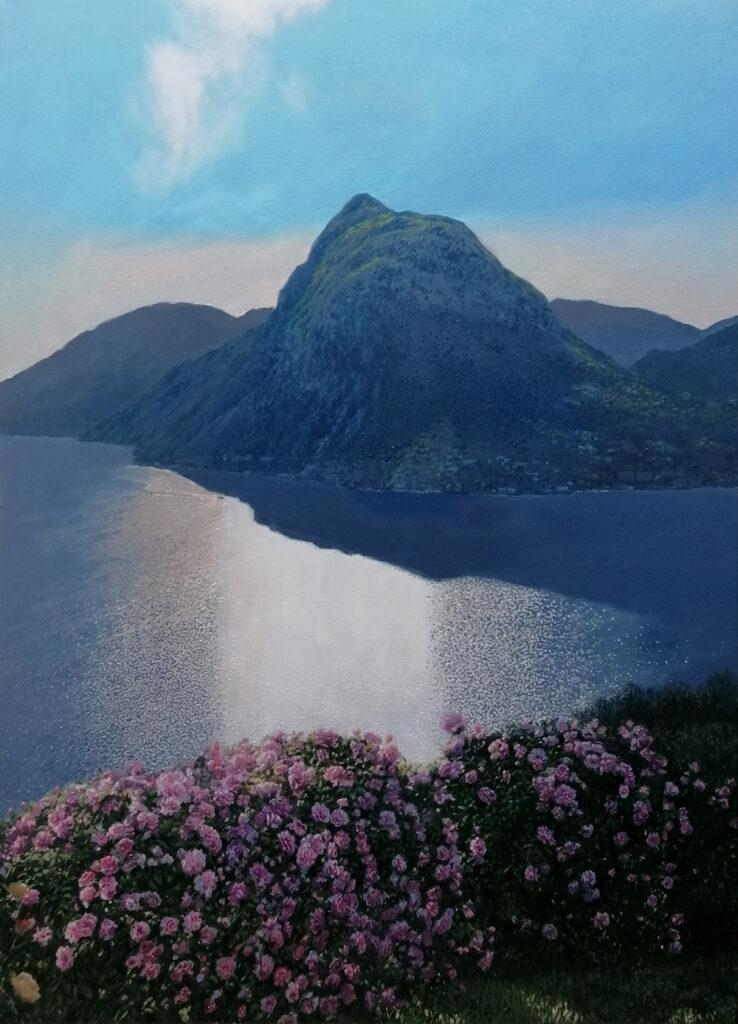
Shadows and Roses (2026) offers a more intimate counterpoint. Abundant pink roses occupy the foreground, overlooking shimmering water and a steep mountain rising across the lake. The delicate flowers, cool blue atmosphere, and monumental geological forms create an interplay between tenderness and endurance, intimacy and distance. Light moves across the water, while the mountain’s shadowed surfaces lend depth and gravity to the composition. The roses might suggest affection, transience, or the cultivated beauty of human experience; the mountain, by contrast, evokes a natural world extending far beyond individual lives. Unlike the more unsettling compositions, this painting allows harmony to retain its presence, even as the title reminds us that beauty and shadow are inseparable.
Considered together, these six paintings reveal that Dempwolff’s artistic concerns cannot be reduced to unease alone. His landscapes also accommodate serenity, nostalgia, wonder, and the pleasure of looking. Their realism provides a recognizable visual language, while their imaginative construction opens that language to emotional and philosophical possibilities. Whether depicting an imagined harbor, a winter plain, a shadowed valley, or a gathering beneath an enormous cliff, Dempwolff encourages viewers to reconsider the relationship between their surroundings and their own inner lives.
Through his international exhibitions, including presentations at the Rothko Museum, Another Art Museum in Guangzhou, and the museums of Greiz through Pashmin Art Consortia, his paintings have entered increasingly diverse cultural contexts. Yet their underlying artistic proposition remains remarkably consistent: the world is never exhausted by its visible appearance. In Dempwolff’s quietly compelling images, landscape becomes a place where memory, perception, and imagination meet, reminding us that what we see is always accompanied by what we feel, remember, and cannot entirely explain.
© Copyright of the text belongs to Dr. Davood Khazaie
Dempwolff’s Website