Helmut Spanner is widely known as an illustrator and picture-book artist, yet his Picturetalks reveal a distinctly conceptual dimension of his practice. In these works, writing itself becomes pictorial material. A selection of eight Picturetalks is currently on view at the Museums of the Castle and Residential City of Greiz (Museen der Schloss- und Residenzstadt Greiz), where the exhibition opened on 3 October and continues through 22 November 2026. Organized by Pashmin Art Consortia, the exhibition brings together works that explore a fundamental question that has occupied poets and artists for more than two millennia: what happens when language is not only read, but also seen?
Spanner’s work can therefore be situated within a remarkably long art-historical tradition. One of its earliest manifestations appears in the Hellenistic Greek technopaegnia, poems in which the arrangement and varying lengths of lines generated recognizable shapes. Among the surviving examples are works attributed to Simias of Rhodes, whose poems take the forms of an Egg, Wings, and an Axe. Other ancient figured poems were shaped as altars or a shepherd’s pipe. These were not illustrations added to poems: the verbal and visual structures were conceived together. The poem existed simultaneously as text and image, and the act of reading was inseparable from the act of looking.
This combination of writing and image continued in the medieval tradition of the carmina figurata. A particularly elaborate example is Hrabanus Maurus’s ninth-century De laudibus sanctae crucis, in which fields of Latin text are organized so that crosses, figures, and additional verbal structures appear within them. Such works ask the reader not merely to proceed through a text line by line but to contemplate the page as a visual and intellectual whole. The page becomes a field in which reading, seeing, memory, and meditation intersect.
The tradition reappeared with particular clarity in seventeenth-century English poetry. In George Herbert’s “Easter Wings,” published in The Temple in 1633, the length of the poetic lines expands and contracts so that the printed poem resembles a pair of wings. The visual form is not decorative: the movement from fullness to diminution and back toward expansion corresponds to the poem’s themes of fall, suffering, resurrection, and spiritual ascent. Herbert’s “The Altar” works according to a related principle. Here again, meaning resides partly in what the words say and partly in the form they collectively assume on the page.
Modernism radicalized this relationship. Guillaume Apollinaire, in his Calligrammes, published in 1918, arranged words into visual configurations that might evoke an object, figure, or movement. In these works typography became a kind of drawing, and poetry entered directly into the visual territory of modern art. Apollinaire’s experiments were followed in the 1950s and 1960s by concrete poetry, an international movement in which words, letters, spacing, repetition, and the blank page became artistic materials in their own right. Concrete poets such as Eugen Gomringer treated language as a spatial construction rather than simply a vehicle for literary narration. Repetition could itself create form: a single word, multiplied and spatially organized, might generate an image, pattern, absence, or rhythm.
It is against this background that the particular innovation of Spanner’s Picturetalks becomes clear. He shares with these predecessors the conviction that a written sign can be both language and image. Yet his method differs significantly from the shaped poems of antiquity, Herbert’s patterned verse, Apollinaire’s calligrams, and much concrete poetry. Spanner does not primarily draw an outline with words, nor does he construct his images typographically. He writes.
The sentences proceed horizontally across the sheet in repeated handwritten lines, often hundreds of times. From a distance they initially resemble dense fields of text. Only gradually do variations in colour, pressure, tonal intensity, and density reveal larger structures. The image is therefore not simply made out of words; it emerges from the repeated physical act of writing them. This is crucial. Typography tends toward reproducibility, whereas handwriting records difference. No two repetitions are exactly identical. Every sentence preserves the movement of the hand at a particular moment. Spanner consequently introduces duration and bodily labour into the history of visual poetry: repetition becomes not mechanical sameness but accumulated time.
His innovation might therefore be described as a movement from the traditional “poem as picture” toward the “picture as accumulated speech.” The viewer must constantly change modes of attention. At close range one reads; at a greater distance one sees tonal fields and latent images. The eye moves back and forth between semantic meaning and visual appearance. Neither mode ever completely replaces the other.
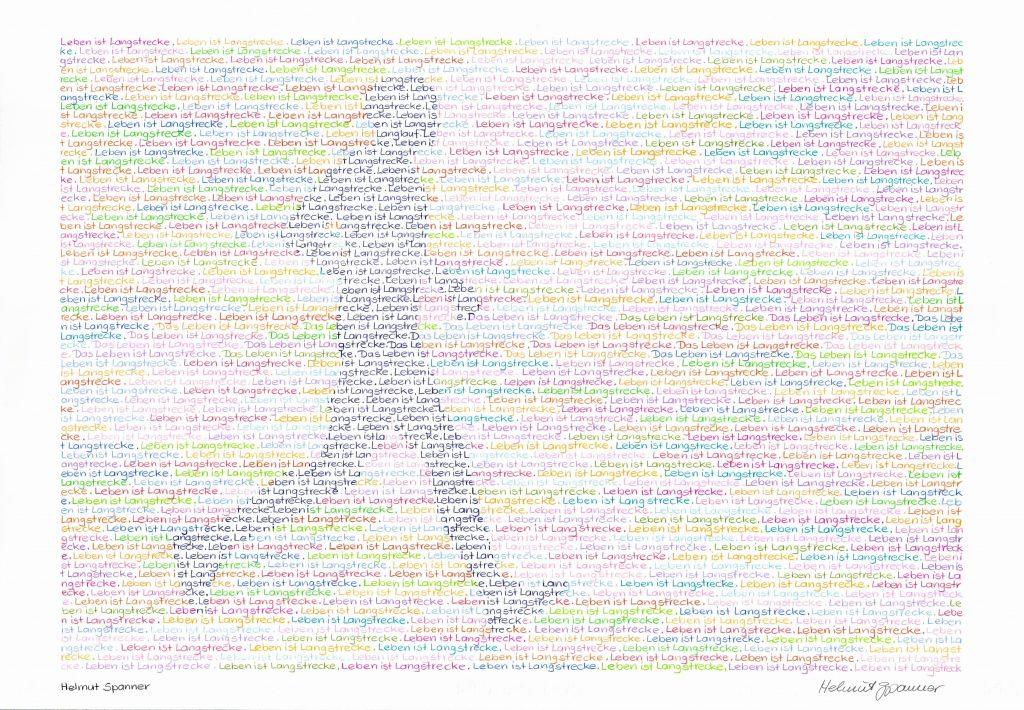
This principle is already explicit in Marathon. Spanner repeatedly writes “Leben ist Langstrecke” (“Life is a long-distance journey”), with passages also using “Das Leben ist Langstrecke.” The sentence extends across the surface in changing colours. Its meaning and its method reinforce one another: life is understood as persistence, continuation, and endurance, while the production of the work itself demands persistence and endurance. The phrase is therefore not simply communicated; it is performed.
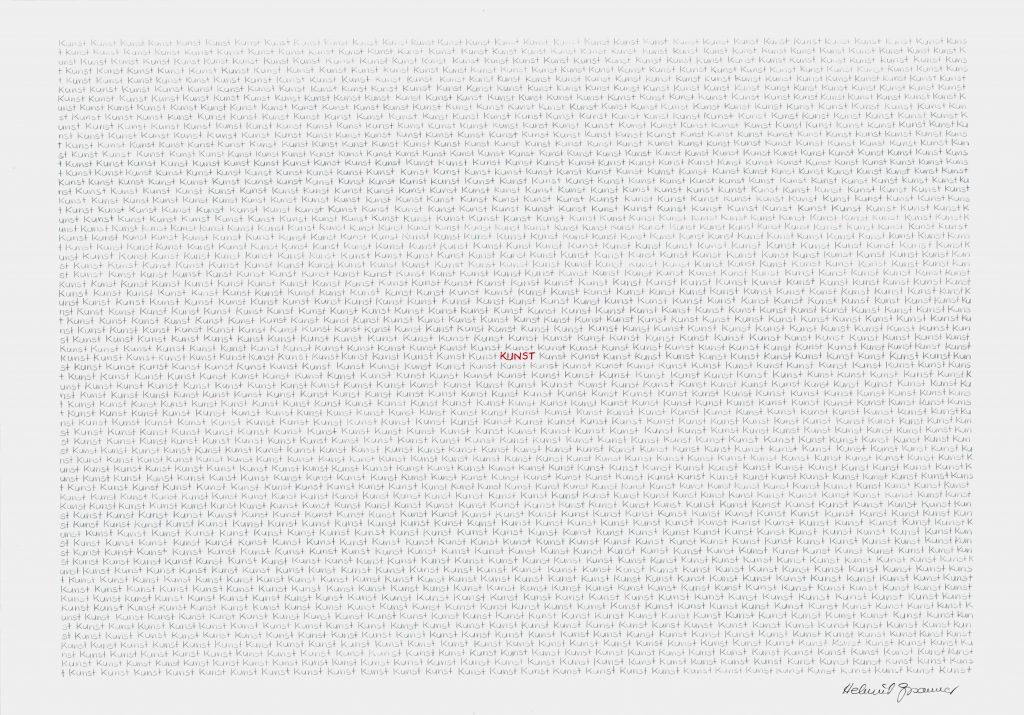
In Kunst, Spanner reduces the principle to a single repeated word: “Kunst” (“art”). Hundreds of grey repetitions cover the surface until one red KUNST interrupts them. The gesture recalls strategies familiar from concrete poetry, in which repetition and spatial differentiation make a word visible as an object. Yet the handwritten character of Spanner’s field prevents perfect uniformity. The solitary red word intensifies a question already latent in every repeated inscription: does art lie in repetition, in deviation, or in our recognition of difference?
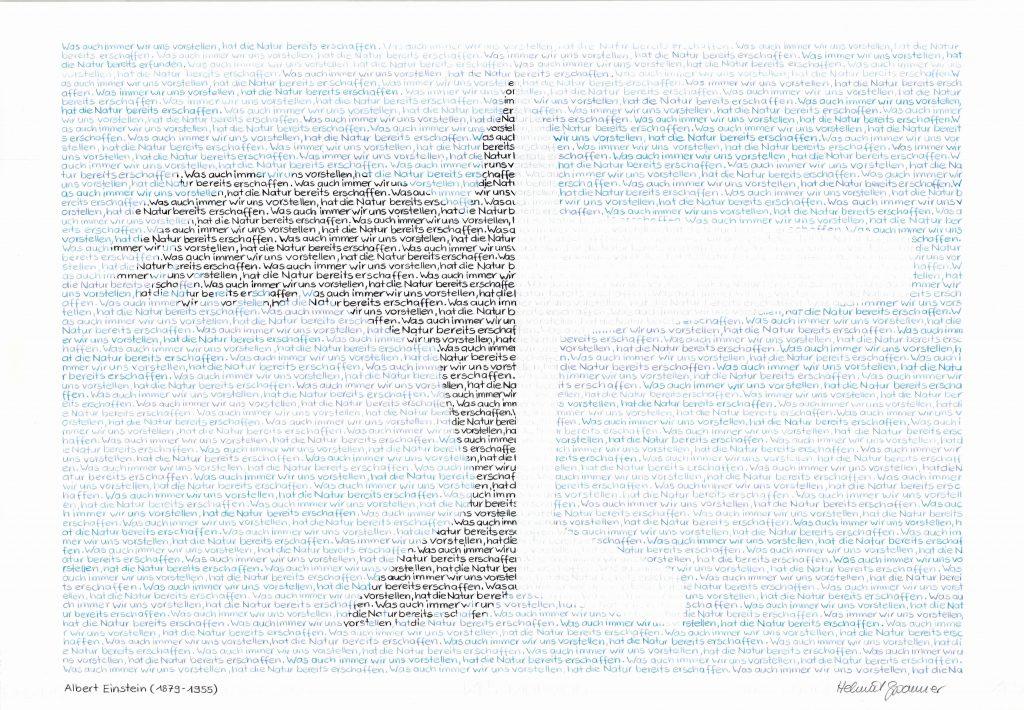
In the works connected with historical personalities, Spanner transforms the same method into an unconventional form of portraiture. Albert Einstein is evoked through the repeated sentence “Was auch immer wir uns vorstellen, hat die Natur bereits erschaffen” (“Whatever we can imagine, nature has already created”). Rather than describing Einstein’s physical appearance, Spanner allows an idea associated with him to produce the image. The portrait emerges from thought.
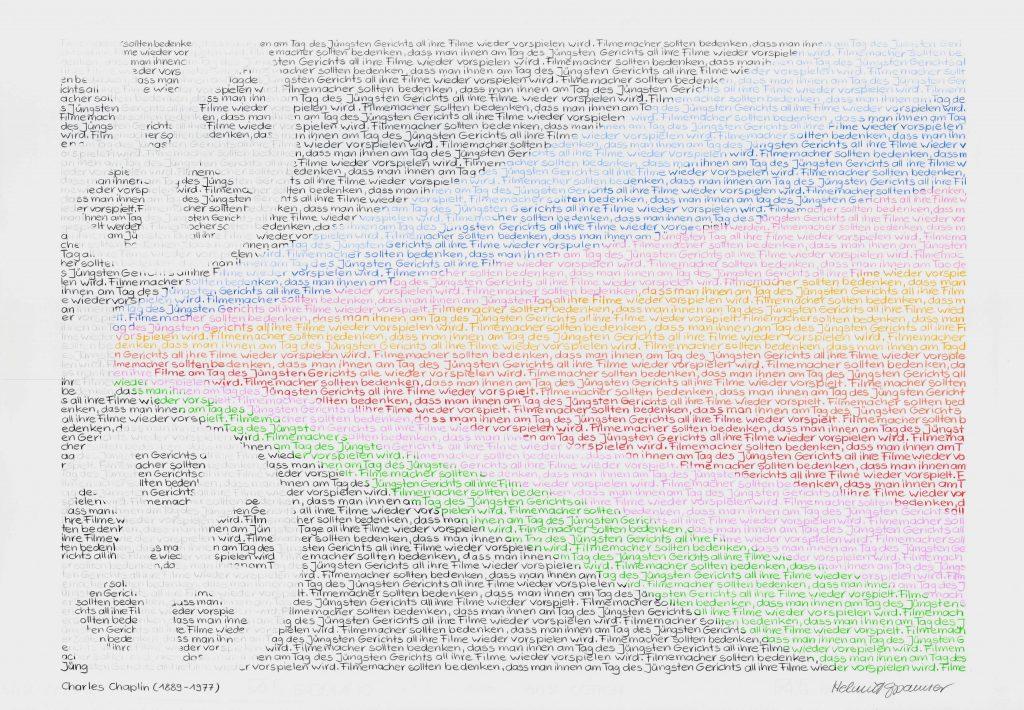
The Charles Chaplin work repeatedly inscribes “Filmemacher sollten bedenken, dass man ihnen am Tag des Jüngsten Gerichts all ihre Filme wieder vorspielen wird” (“Filmmakers should bear in mind that on the Day of Judgment all their films will be played back to them”). The humour of the statement changes through multiplication. The imagined replaying of films is mirrored by the endless replaying of the sentence itself: repetition becomes both form and joke.
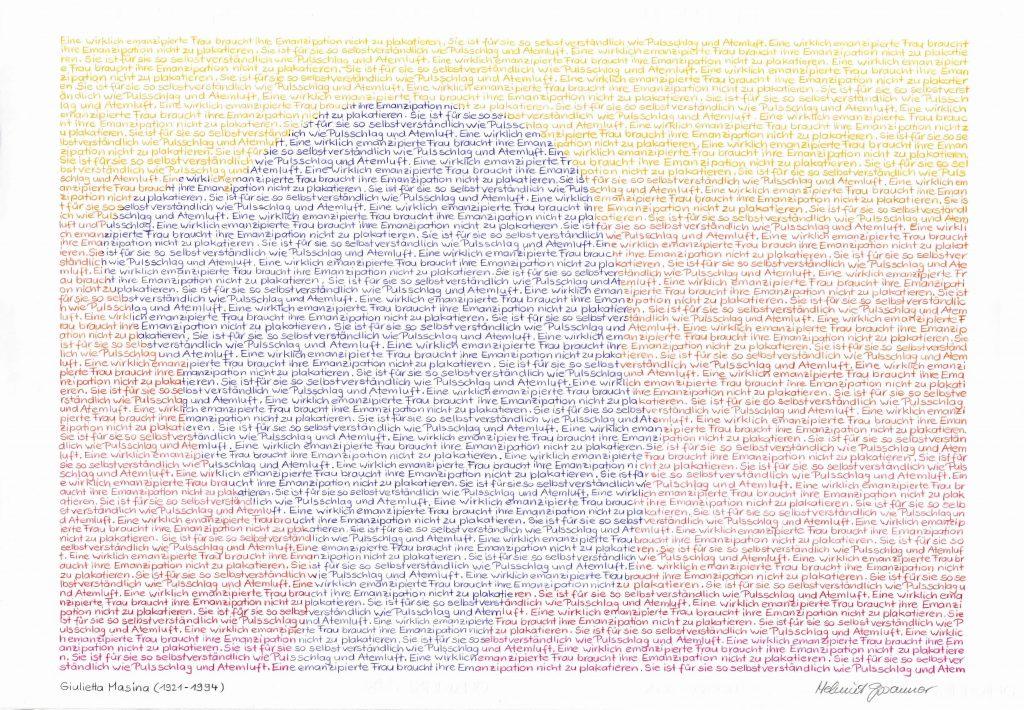
For Giulietta Masina, Spanner writes: “Eine wirklich emanzipierte Frau braucht ihre Emanzipation nicht zu plakatieren. Sie ist für sie so selbstverständlich wie Pulsschlag und Atemluft” (“A truly emancipated woman does not need to display her emancipation. For her it is as self-evident as pulse and breathing”). Here changing yellows, reds, oranges, and blues transform repetition into sustained affirmation.
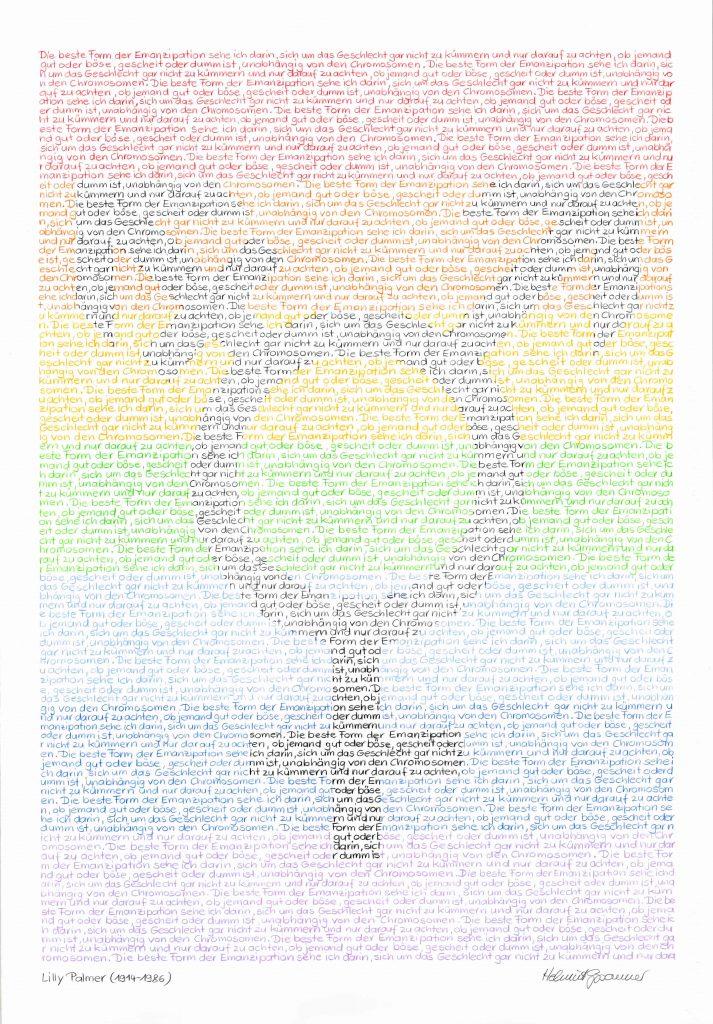
In 3 Fach Symbol (2024), Spanner turns Lilly Palmer’s reflection on emancipation into a vivid field of repeated handwriting. The flowing bands of red, orange, yellow, green, blue, and violet visible in the work evoke a spectrum of diversity and, in a contemporary context, inevitably suggest questions of gender and identity. Against this visual multiplicity, Palmer’s words argue for a human value beyond gender categories, creating a productive tension between difference and equality. As elsewhere in Spanner’s Picturetalks, repetition transforms the quotation into both image and sustained reflection.
He repeatedly writes: “Die beste Form der Emanzipation sehe ich darin, sich um das Geschlecht gar nicht zu kümmern und nur darauf zu achten, ob jemand gut oder böse, gescheit oder dumm ist, unabhängig von den Chromosomen.“
(“I see the best form of emancipation as not concerning oneself with gender at all, but simply paying attention to whether a person is good or bad, intelligent or foolish, regardless of their chromosomes.”)
Mark Twain introduces irony through the sentence “Gott hat den Menschen erschaffen, weil er vom Affen enttäuscht war. Danach hat er auf weitere Experimente verzichtet” (“God created man because he was disappointed with the ape. After that he gave up further experiments”). Its continuous recurrence amplifies the joke until humour becomes visual insistence.
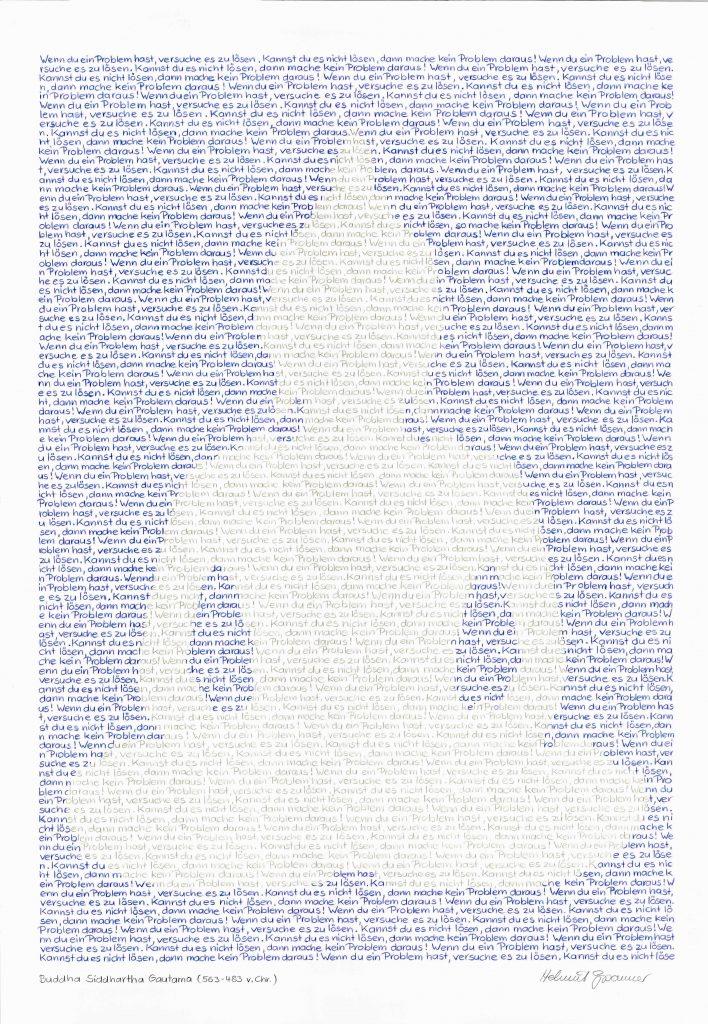
Finally, the Picturetalk dedicated to Buddha Siddhartha Gautama repeats “Wenn du ein Problem hast, versuche es zu lösen. Kannst du es nicht lösen, dann mache kein Problem daraus!” (“If you have a problem, try to solve it. If you cannot solve it, then do not make a problem out of it!”). Here the repetitive act comes especially close to mantra and meditation. Darker and lighter passages accumulate into a latent presence within the writing; the viewer moves almost imperceptibly from reading advice to contemplating an image.
Seen within the history of visual poetry, Spanner’s Picturetalks are therefore neither a revival of the ancient shaped poem nor simply an extension of concrete poetry. Their distinctive achievement lies in bringing handwriting, repetition, duration, portraiture, and quotation together. Whereas Simias, Herbert, and Apollinaire made the visual arrangement of language correspond to a recognizable form, Spanner allows form to emerge from the accumulated act of writing itself. His images are made not only of words, but of time spent writing words. In this sense, the Picturetalks extend an ancient dialogue between literature and visual art while giving it a contemporary and intensely personal form: thought becomes gesture, gesture becomes texture, and language—without surrendering its meaning—becomes image.
© The copyright of the text belongs to Dr. Davood Khazaie
Find out more at the Greiz Website