Introduction
Kiko Morales, born Francisco Morales Muñoz in Doña Mencía, Spain, in 1996, is a contemporary figurative artist trained at the Alonso Cano Faculty of Fine Arts at the University of Granada. His practice is centred primarily on drawing on paper, combining black pen, coloured pencil, and restrained applications of acrylic. From an early stage, his work developed through a distinctive fusion of anatomical precision, symbolic imagery, botanical forms, and psychologically charged representations of humans and animals.
Morales’s work has also entered an expanding international context through exhibitions organised by Pashmin Art Consortia. He participated in “Transcendence: A Fusion of Art and Culture” at the Hong Art Museum in Chongqing, China, in 2023-2024, and in “Reflections and Resonances” at the Museen der Schloss- und Residenzstadt Greiz in Germany in 2025. A further exhibition at Kunsthaus Weiz in Austria is scheduled for 24 September to 7 November 2026. All these exhibitions were organized and curated in conjunction with Pashmin Art Consortia.
Figuration as an Ethics of Attention
Morales’s drawings construct worlds in which vulnerability is neither hidden nor transformed into spectacle. Working with bodies, animals, organs, flowers, celestial signs, and objects charged with social meaning, he builds tightly controlled compositions that often develop along a pronounced vertical axis. These arrangements resemble altars, anatomical diagrams, family trees, or psychological maps.
Although the works are figurative, they do not function as conventional narratives. Their components are stacked, mirrored, intertwined, or bound together, creating systems rather than scenes. Human and animal life is exposed to time, illness, desire, envy, solitude, and social judgement. Morales’s subject is therefore not simply suffering, but the structures through which suffering is experienced and carried.
The white backgrounds of several drawings intensify this sense of containment. Everything significant occurs within the central body of the image, while the surrounding emptiness provides no obvious route of escape. In the darker works, dense vegetation and celestial space create similarly enclosed environments. Morales does not invite the viewer into an open landscape; he asks us to confront a condition.
Animal Fables: Solitude, Effort, and Social Appearance
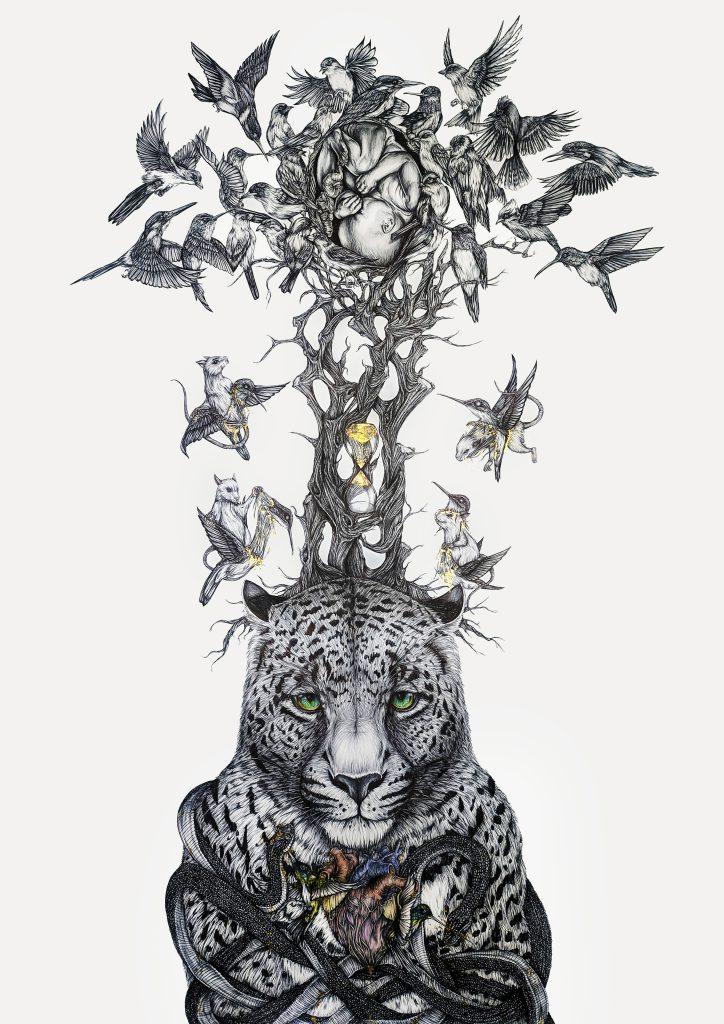
This structural logic is especially evident in “A Lonely Road”. At the base, a leopard faces the viewer with an unwavering green gaze while serpentine forms bind its body. Above it rises a brittle, tree-like structure inhabited by mice, birds, an hourglass, and a suspended fetus. The course of life becomes an unstable ecology in which creatures gather, separate, consume, and endure, while time remains fixed at the centre.
Morales describes the work as a fable about the human journey, which begins in the company of many and ends with only those who genuinely value us. The image offers no sentimental resolution. Solitude is not represented as an empty landscape; it is constructed as a dense system in which physical proximity does not necessarily prevent emotional isolation.
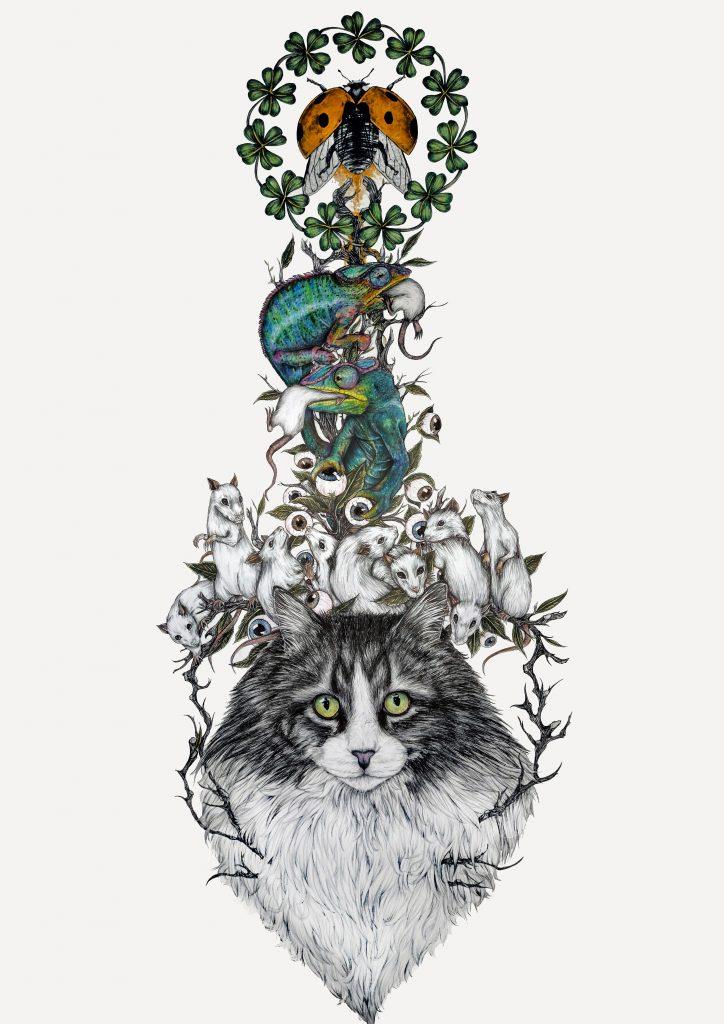
“Luck or Constancy?” employs a similar vertical accumulation, but with a more satirical tone. A large cat anchors the composition while mice crowd above its head, chameleons seize prey, disembodied eyes appear among branches, and a ladybird is enclosed within a crown of four-leaf clovers. Symbols traditionally associated with luck occupy the highest point, yet the entire composition is sustained by vigilance, appetite, struggle, and persistence.
The artist identifies the work as a criticism of the way achievement is often reduced to good fortune by those who refuse to recognise the effort behind it. The question posed by the title remains unresolved. Luck may crown the image, but constancy appears to support its entire weight.
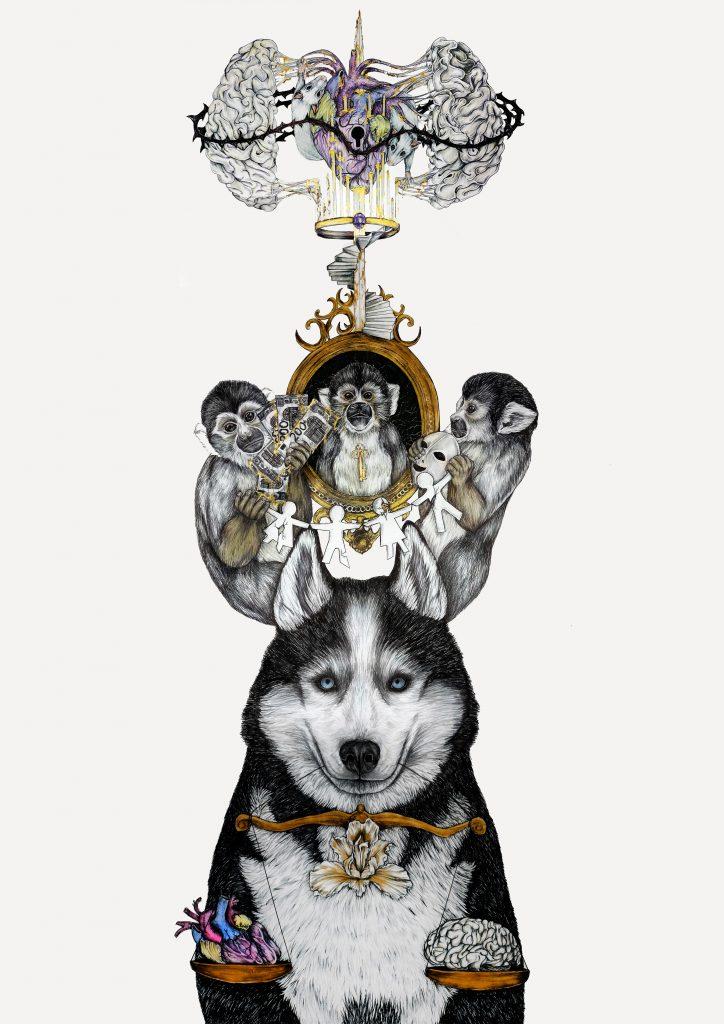
The social criticism becomes still more explicit in “True to Ourselves”. A husky carries a set of scales balancing a heart and a brain, while monkeys above it handle money, a mask, a key, and we see a monkey in a mirror. At the summit, two exposed brains are connected to a wounded, colourful heart and crossed by a thorn-like band.
The work addresses people who construct identities for public approval, living beyond their means and pretending to be what they are not in order to gain acceptance. Morales translates this behaviour into a hierarchy of judgement and display. The mirror, mask, currency, and scales suggest that identity has become something measured, purchased, concealed, and evaluated. In contrast, the dog’s direct gaze conveys an animal presence that appears less divided than the human social structures arranged above it.
The “Resilience” Series: Illness and Renewal
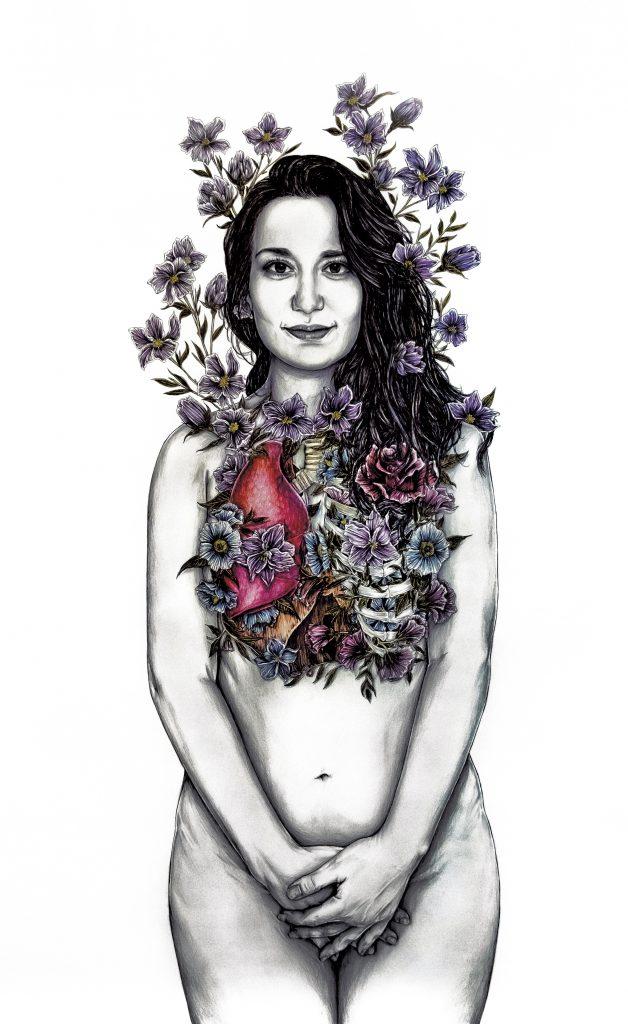
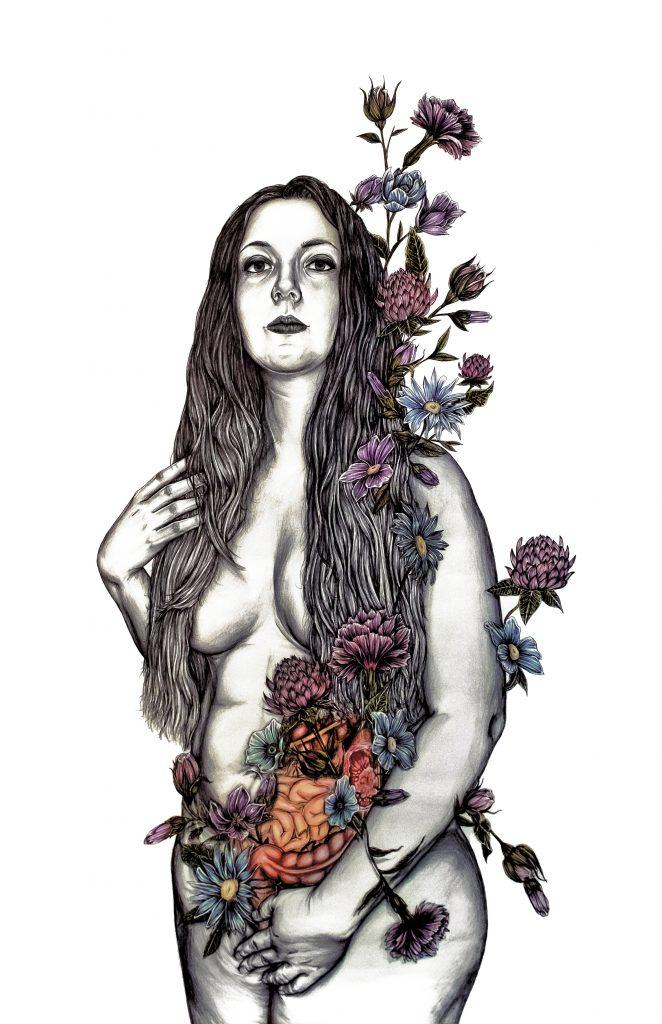
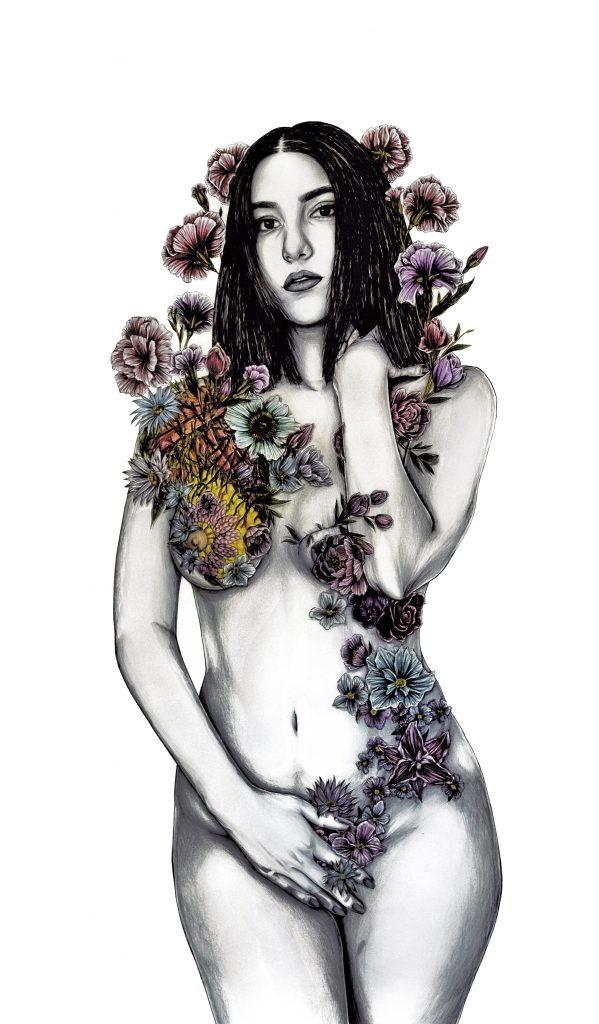
The selected works from the 2019 “Resilience” series bring the question of endurance directly into the human body. In “Resilience (Breast Cancer)”, “Resilience (Colon Cancer)”, and “Resilience (Lung Cancer)”, nude women stand against unadorned white grounds. Their bodies are rendered largely in monochrome, while flowers and affected organs emerge in concentrated colour.
The contrast is visually beautiful, but the works resist decorative comfort. Anatomy remains exposed, and the flowers do not erase illness; they share the same bodily space. Morales conceived the series as a tribute to his mother’s recovery from cancer and to the new opportunity experienced by those who survive the disease. This personal origin gives the works tenderness, while their frontal presentation prevents that tenderness from becoming pity.
Each image locates vulnerability differently. In “Resilience (Breast Cancer)”, flowers spread across the breast and descend along the torso, turning the affected area into a site of continued growth. In “Resilience (Colon Cancer)”, the intestines appear vividly within a floral cluster held close to the body, as though the figure were simultaneously protecting and presenting her own interior. In “Resilience (Lung Cancer)”, the rib cage opens into a dense arrangement of lung, heart, flowers, and leaves.
The women’s composed expressions counter the violence of anatomical exposure. Resilience does not mean returning to an untouched state. It means remaining present in a body that has been altered, examined, and threatened. The flowers coexist with illness, while the figures’ calmness makes resilience less a heroic victory than a refusal to disappear.
Relational Vulnerability: Friendship and Entrapment
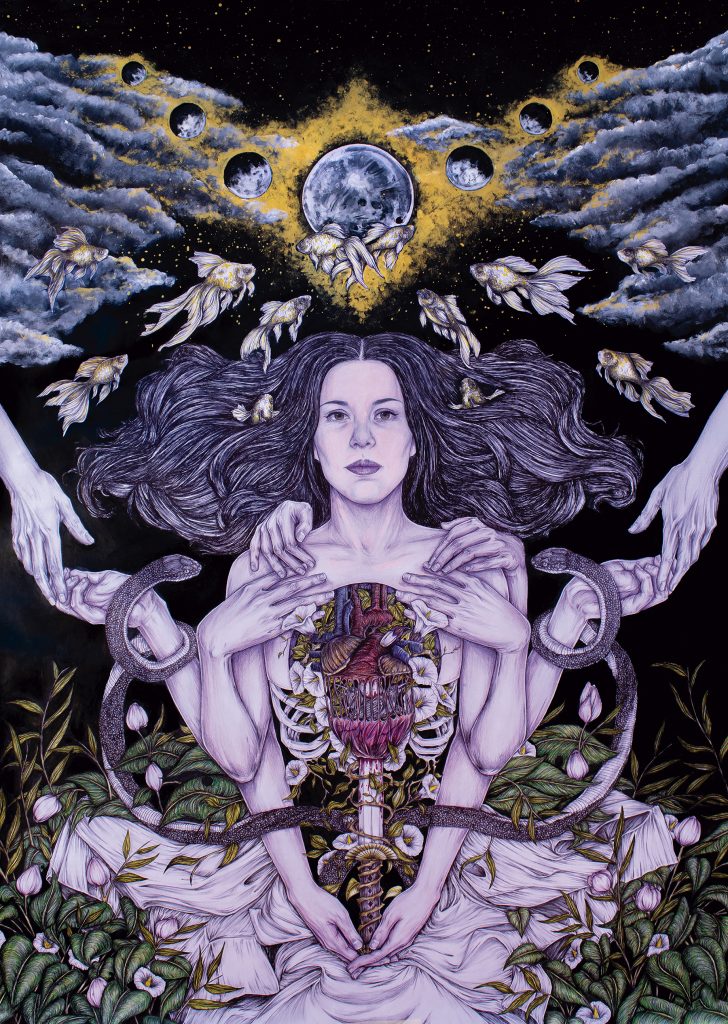
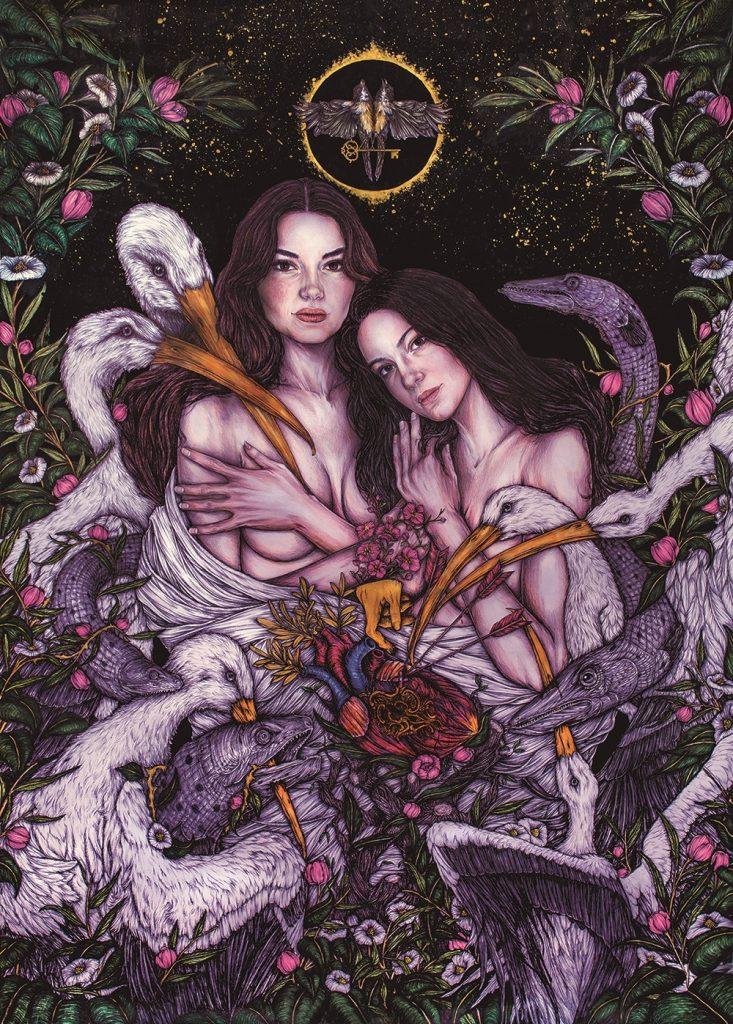
Morales extends his concern with physical vulnerability into the field of emotional dependence in “Έκλειψη (Eclipse)” and “Έλα (Come)”.
“Έκλειψη” is described by the artist as an ode to true friendship and a gesture of gratitude towards those who offer support when life becomes dark. Two women hold one another at the centre of a dense nocturnal garden populated by birds, crocodilian forms, flowers, and a guarded heart. Above them, two birds face each other within a golden eclipse, accompanied by a key.
The surrounding creatures do more than decorate the scene. They establish an environment of danger and protection in which intimacy becomes a form of shelter without becoming an escape from darkness. The eclipse suggests a temporary suspension of light: a difficult condition endured through the presence of another person.
“Έλα”, by contrast, presents a more disturbing relational condition. Morales describes it as the story of an abused woman who knows she must leave but remains trapped by a destructive desire that slowly consumes her. The central figure is multiplied through several arms, some belonging to her and others entering from outside the composition. Snakes coil around their bodies, fish move beneath phases of the moon, and the chest opens to reveal the heart and rib cage.
The title, “Come”, becomes painfully ambiguous. It may be an invitation, a command, a temptation, or a call to return. Unlike “Έκλειψη”, where closeness offers support, “Έλα” shows intimacy becoming entanglement. The body is surrounded by contact, yet none of that contact guarantees safety.
Controlled Technique, Unresolved Meaning
Across these works, Morales repeatedly joins visual precision to moral uncertainty. His lines are disciplined, his compositions centrally organised, and his colours carefully restricted. Selective colour intensifies organs, flowers, eyes, and symbolic objects without overwhelming the underlying drawing. Colour becomes a marker of pressure and psychological tension rather than general decoration.
Yet the questions posed by the images remain unstable. Is success earned or granted? Does community protect us from solitude? Can beauty coexist with illness without concealing it? When does attachment become captivity? Morales does not answer these questions through fixed allegorical meanings. Animals, flowers, organs, masks, celestial signs, and anatomical forms function as participants within larger psychological and social systems.
The Quiet Force of Endurance
What ultimately unites the series is an ethics of looking. Morales asks the viewer to remain with exposed conditions rather than quickly transform them into redemption, tragedy, or spectacle. His figures do not plead, and his animals do not simply illustrate human qualities. They hold their positions.
In this sustained stillness, endurance becomes the central action of the work: the capacity to inhabit a wounded body, an uncertain identity, an unequal relationship, or a solitary path without disappearing from view. Morales’s drawings do not promise resolution. Their force comes from the seriousness with which they remain beside what cannot easily be repaired, explained, or overcome.
Dr. Davood Khazaie
(Literary Art Critic and International Curator)
© The copyright of the text belongs to Dr. Davood Khazaie
See more about Kiko Morales