From Poland to Bielefeld
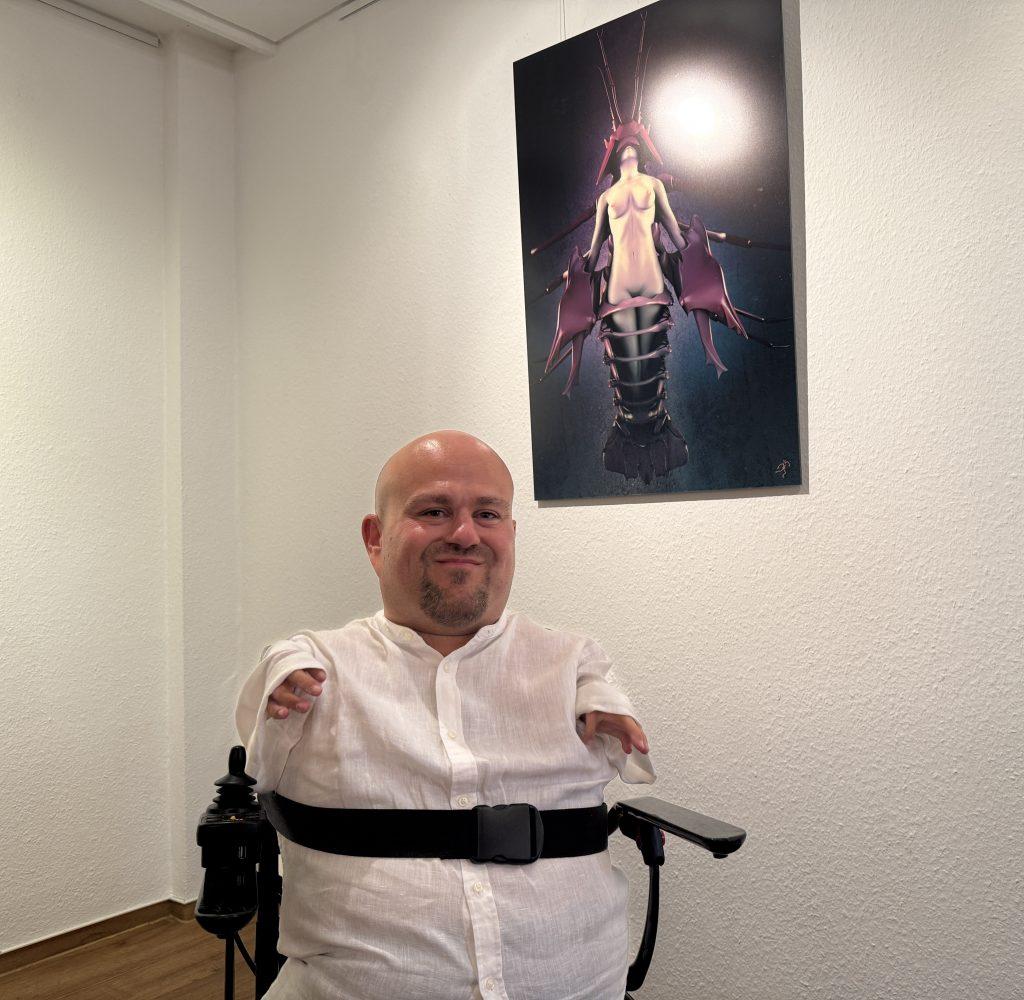
Martin Ryng is a Polish-born German artist who developed his artistic practice after moving to Bielefeld. Born in 1984 in Ząbkowice Śląskie, Poland, he completed his Abitur in 2003 and initially studied sociology before relocating to Germany. After a language course in Bielefeld, he entered the Fachhochschule Bielefeld in 2005 and completed a diploma in design in 2009. Drawing, computer graphics, animation and 3D visualisation became increasingly intertwined during these years. For Ryng, the digital image is not simply a technical surface, but a space in which the human body can be dismantled, rebuilt and made to carry psychological meaning. Despite living with a severe physical disability, Ryng has sustained this demanding practice over many years, continuing to develop an extensive body of digitally constructed work with precision and consistency.
The Zodiac as Psychological Structure
The zodiac has deep roots in ancient Mesopotamian astronomy and astrology. By the classical period, Greek and Roman traditions had developed the twelve-sign system familiar today, linking constellations and planetary movements with ideas about character, fate and events on Earth. Whether understood historically as cosmology, divination or symbolic order, the zodiac offered a way of imagining a correspondence between the heavens and human life. Ryng reactivates this inherited vocabulary without presenting it as literal belief: the signs become psychological archetypes through which defence, strength, identity and transformation can be visualised.
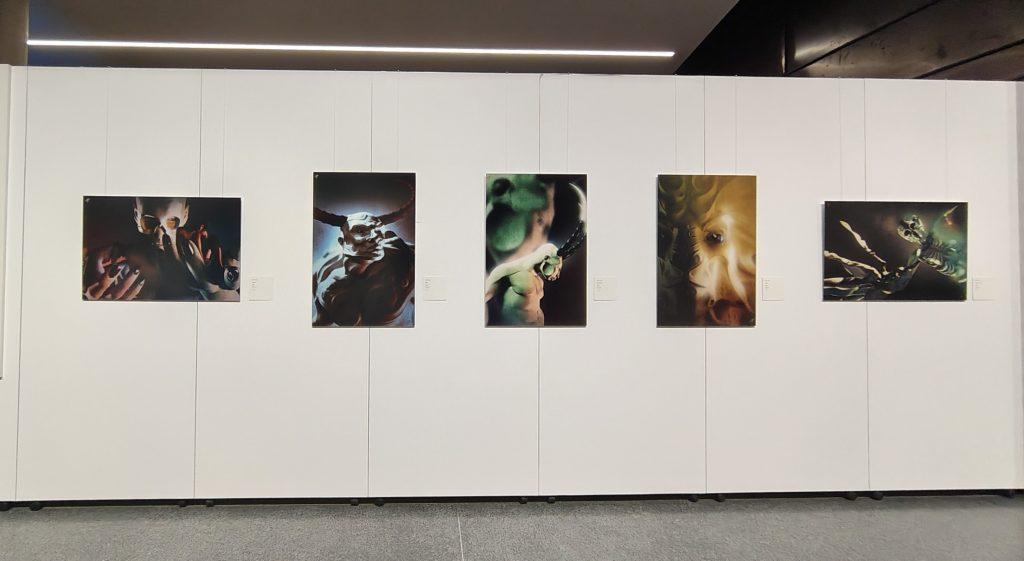
Against this ancient symbolic background, the seven works presented in Weiz – “Krebs” (Cancer), “Löwe” (Leo), “Skorpion” (Scorpio), “Steinbock” (Capricorn), “Stier” (Taurus), “Waage” (Libra) and “Wassermann” (Aquarius) – use the zodiac as a psychological structure rather than an illustrative theme. Ryng does not merely attach animal attributes to human figures; he makes the body struggle with them. Shells, horns, tails, masks and bones become extensions of inner states. Protection can become imprisonment, strength can become burden, and identity can become unstable or divided.
“Krebs” (Cancer): Breaking the Shell
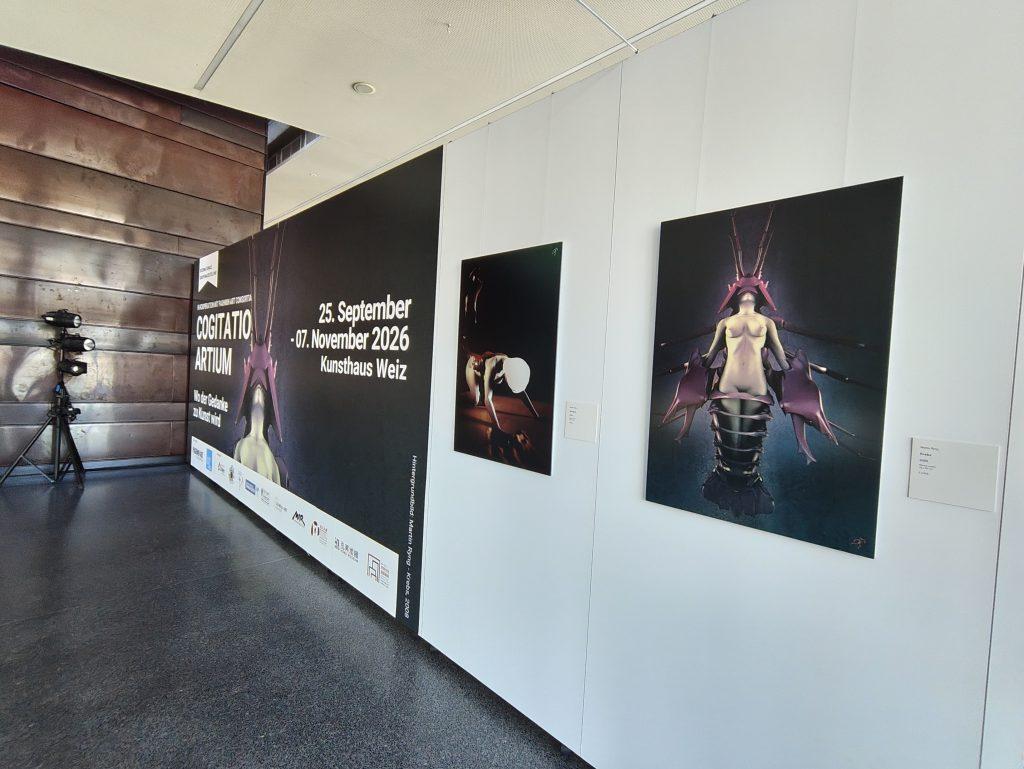
These seven works are on view at Kunsthaus Weiz in the international group exhibition “Cogitatio Artium – Wo der Gedanke zu Kunst wird”, running from 25 September to 8 November 2026. Organized jointly by Pashmin Art Consortia and Kunsthaus Weiz, the exhibition places Ryng’s zodiac cycle within a broader international dialogue and is curated by Nour Nouri of Pashmin Art Consortia, Dr. Davood Khazaie, International Curator at Pashmin Art, and Georg Gratzer of Kunsthaus Weiz.
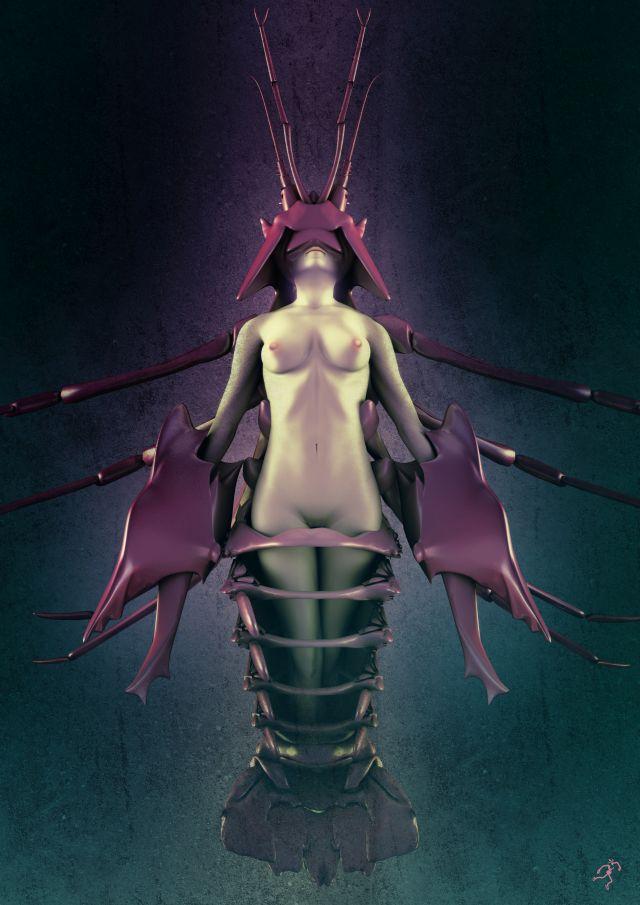
This tension is most explicit in “Krebs” (Cancer). The nude figure appears enclosed within the hard architecture of a crustacean body, yet she does not seem passively trapped inside it. Her exposed body pushes upward and outward, as if breaking through a shell that has become dangerous. Flesh and exoskeleton represent opposing conditions: one vulnerable and alive, the other armoured, segmented and controlling.
The shell, normally associated with protection, is therefore reversed. What once defended the body now threatens to contain or immobilise it. The figure’s emergence can be read as an act of resistance – a struggle to escape a defence mechanism that has become a prison. Liberation, the work suggests, may require breaking through the structures that once made survival possible.
Defence, Power and Burden
In “Skorpion” (Scorpio), vulnerability and danger are fused into the same organism. The crouching body is exposed while the segmented tail rises above it like a weapon. Yet the threat does not come from outside: it grows from the figure itself. Self-protection becomes psychologically heavy, perhaps even dominating.
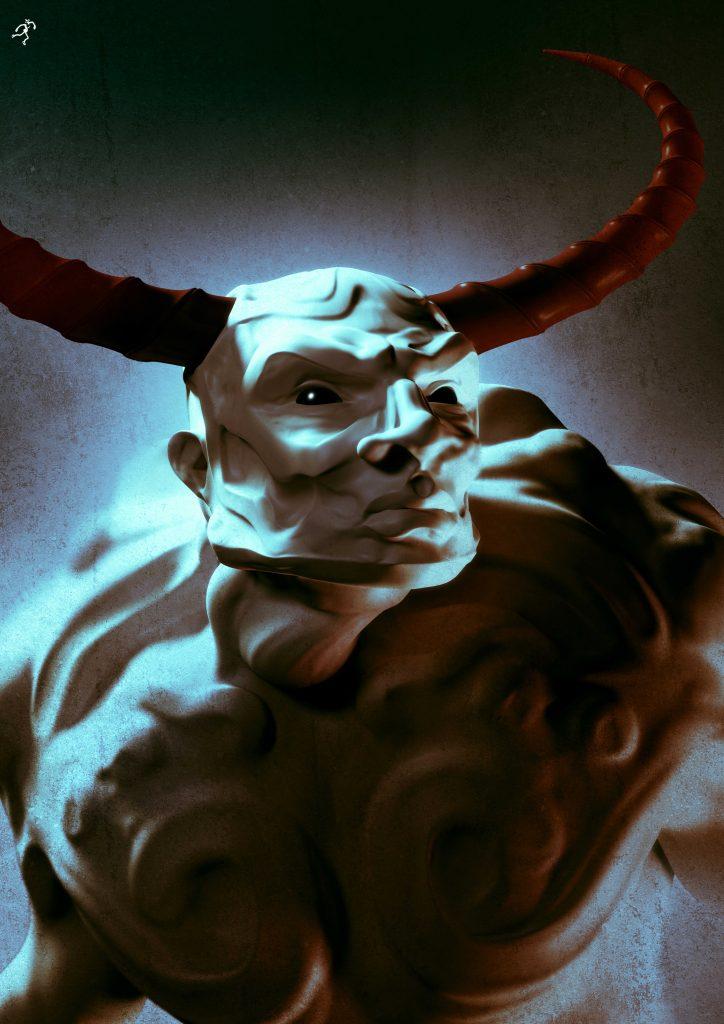
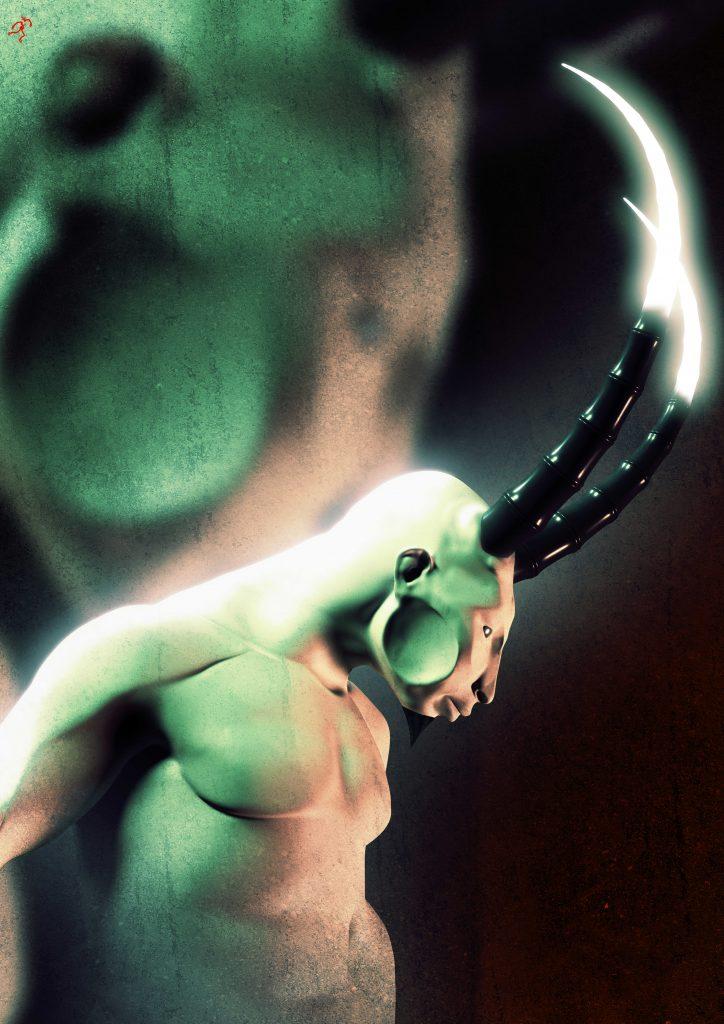
“Steinbock” (Capricorn) and “Stier” (Taurus) continue this tension between strength and burden. Their horns suggest force, endurance and instinct, but lowered heads, distorted anatomy and artificial illumination complicate any heroic reading. Power is not presented as freedom. Instead, the body seems compelled to carry the symbols that define it, turning strength itself into a weight.
Masks, Balance and Transformation
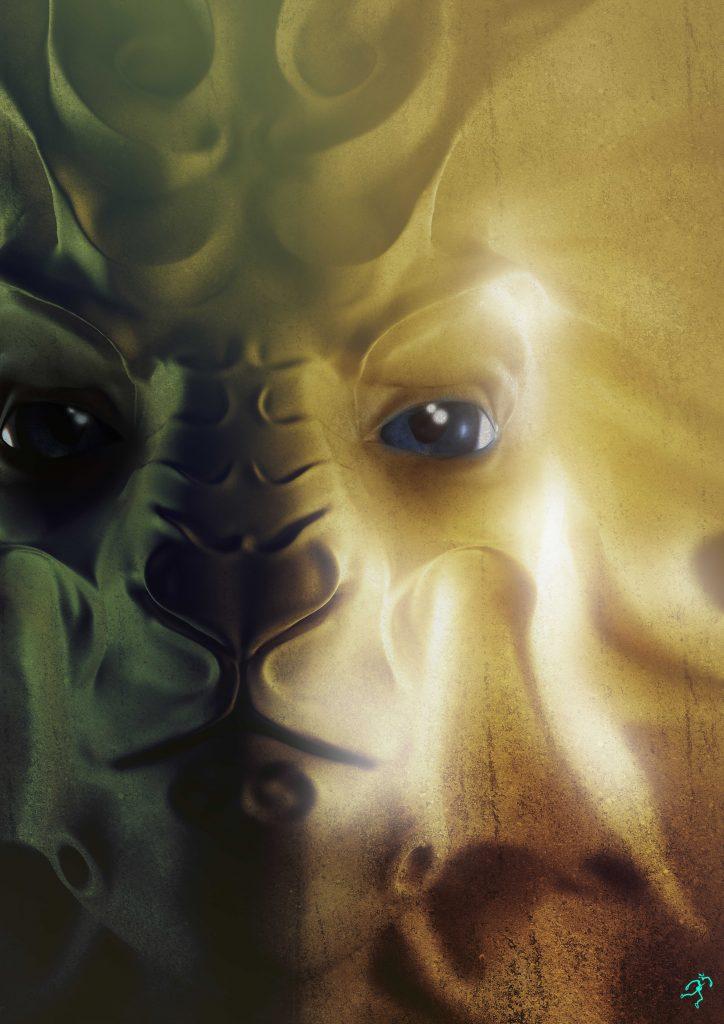
“Löwe” (Leo) turns this instability inward. The close-up face is swollen, mask-like and unevenly illuminated, while the eye remains intensely present. Rather than presenting the lion as a simple emblem of pride or authority, Ryng creates a conflict between visibility and concealment: the face wants to be seen, yet it is also becoming a mask.
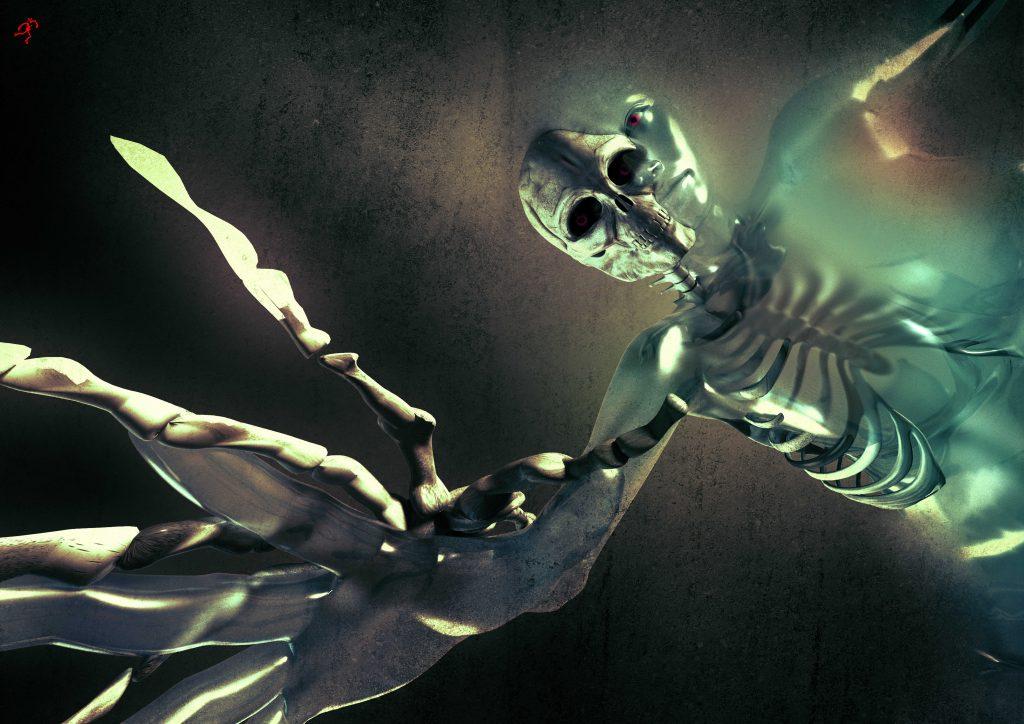
In “Waage” (Libra), the traditional scales disappear. Monumental hands and a large face surround smaller human figures, suggesting judgment, control and the difficult task of holding opposing states at once. Balance becomes negotiation rather than harmony. In “Wassermann” (Aquarius), the body approaches dissolution. Skeletal forms stretch across the composition as though identity were passing from one state into another. The expected vessel is absent; what seems to flow is the body itself – from flesh toward bone, from one form toward another.
Pashmin Art: An International Exhibition Context
Ryng’s recent exhibition history with Pashmin Art has placed his work within an increasingly international context. In 2025, his work was presented in “Reflections and Resonances: Contemporary Art in Historic Greiz” at the museums of the Upper and Lower Castles in Greiz, Germany. This was followed by “Fusion of Horizons: Contemporary Art in Dialogue” at the Hong Art Museum in Chongqing, China, from 2025 to 2026. In September 2026, Pashmin Art Gallery Hamburg included him in “Form: Human And Geometric”. The current presentation at Kunsthaus Weiz continues this trajectory, bringing Ryng’s digitally constructed bodies into dialogue with an international group of contemporary artistic positions.
The Body as Inner Architecture
Across the series, Ryng uses digital modelling to make psychological conflict physical. His figures are impossible anatomies, yet the emotions they embody are recognisably human. The zodiac becomes a vocabulary for inner life, while the body becomes an architecture in which fear, defence, desire, endurance and transformation are made visible. Ryng’s strongest images show the moment when protection becomes confinement, power becomes burden, or identity begins to break open and change.
© The copyright of the text belongs to Dr. Davood Khazaie
Find out more at the Weiz Website