Introduction
Born in 1978, Olena Linse is a Swiss artist whose paintings explore femininity, identity, sensuality and the inner life of the body. She began studying drawing and painting at a young age and later completed studies in urban planning at the Technical University of Rivne. After periods in the Czech Republic and Austria, she settled in Zurich in 2010, making Switzerland the center of her personal and professional life.
Linse’s major international exhibitions have been developed in collaboration with Pashmin Art Consortia, which has played an important role in presenting her work to audiences in Europe and Asia. Her association with Pashmin Art began in 2015, when her work was presented in a museum exhibition in Beijing. Further projects followed in Hamburg, Paris, New York, Beijing, Shanghai and Chongqing.
The present selection of paintings will be exhibited at the “Museums of the Castle and Residential City of Greiz” (Museen der Schloss- und Residenzstadt Greiz), from 3 October to 22 November 2026. Bringing together works created between 2018 and 2024, the presentation offers a concentrated view of Linse’s artistic development, from recognizable representations of the female body to increasingly abstract images of sensuality, autonomy and transformation.
A Language of Oil, Color and Ornament
Linse works primarily in oil and has developed a recognizable visual language situated between figuration and abstraction. Her compositions are dominated by glowing orange, copper, red and brown, often contrasted with black, white and gray. These warm colors give the body vitality and physical presence, while the darker areas introduce mystery, psychological tension and a sense of interior depth.
A characteristic feature of her technique is the use of small dots, circles, cellular structures and honeycomb-like patterns. These marks give the painted surface a tactile, almost relief-like quality. The body appears both smooth and fragmented, sensual and constructed. It resembles a mosaic assembled from sensations, memories and emotional states.
Her figures are rarely conventional portraits. Faces may be absent, partly concealed or reduced to a single eye. The body is often cropped so closely that it becomes a landscape of curves, borders and symbolic forms. The critical monograph “Olena Linse – Labyrinth” published by Pashmin Art Publisher describes her approach as a movement away from the representation of specific individuals and toward an understanding of the face and body as a landscape of the soul.
The Body as Moon and Inner Landscape
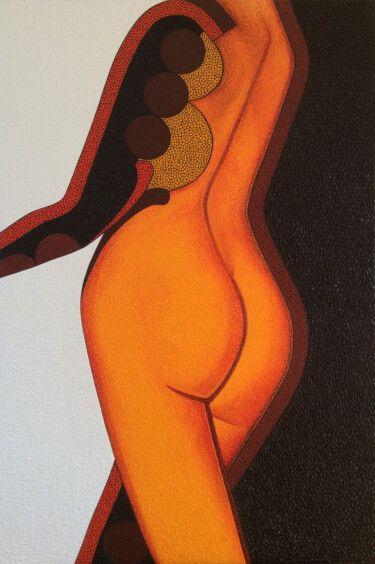
In “Luna”, created in 2018, the female body is shown from the side and from behind. The composition is dominated by the flowing curves of the hips, back and raised arm. Orange and yellow tones make the skin appear luminous, as though the body were illuminated from within.
Circular forms near the shoulder evoke lunar phases, repetition and natural cycles. The figure’s glowing color and flowing contours recall moonlight, transformation and rhythm. The mosaic-like patterns contrast with the smoothness of the hips and back, suggesting that sensuality coexists with complexity, mystery and inner strength.
Looking and Being Seen
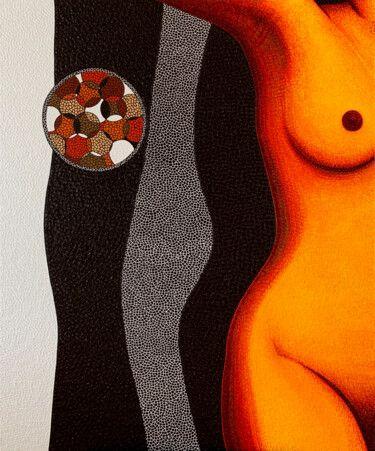
“Blickfang / Eye-Catcher” examines the relationship between the female body and the act of looking. A cropped female torso occupies one side of the canvas, while the other contains undulating bands of black and gray. A circular ornament resembles an eye, lens or jewel.
The title acknowledges the body’s ability to attract attention, but the eye-like form complicates the relationship between the viewer and the figure. The woman is not simply observed; the composition appears to return the viewer’s gaze. The discussion in “Olena Linse – Labyrinth” places the work within Linse’s broader challenge to the traditional male gaze. By giving the body weight, texture and material presence, she resists a superficial or idealized form of observation.
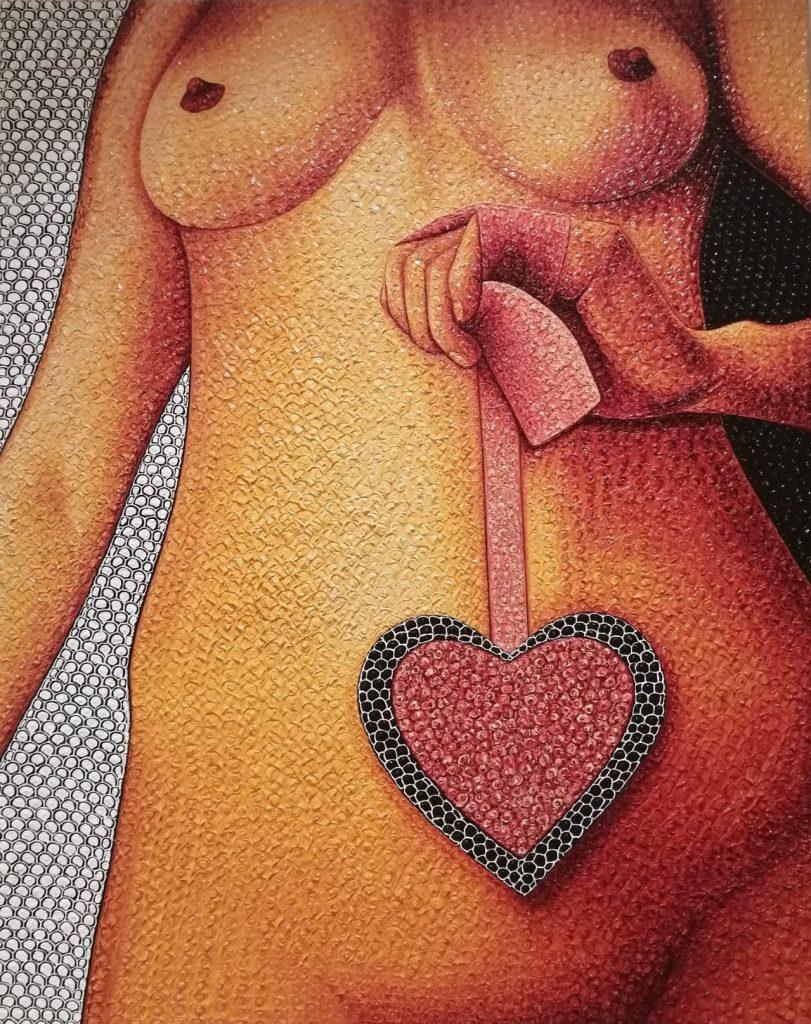
In “Liebe mit sich Selbst / Self-Love”, attention turns from the external gaze toward inward recognition. A nude woman holds a heart-shaped object near her lower abdomen. The gesture is intimate and self-directed. Love is not offered to an absent partner but returned to the figure herself.
The monograph interprets the heart as a link between emotional self-acceptance and physical autonomy. The figure’s nudity communicates vulnerability, but also the strength required to recognize and care for one’s own needs. The painting challenges the assumption that love and desire must always be directed outward and instead presents self-compassion as an empowering emotional experience.
Fertility, Identity and Feminine Power
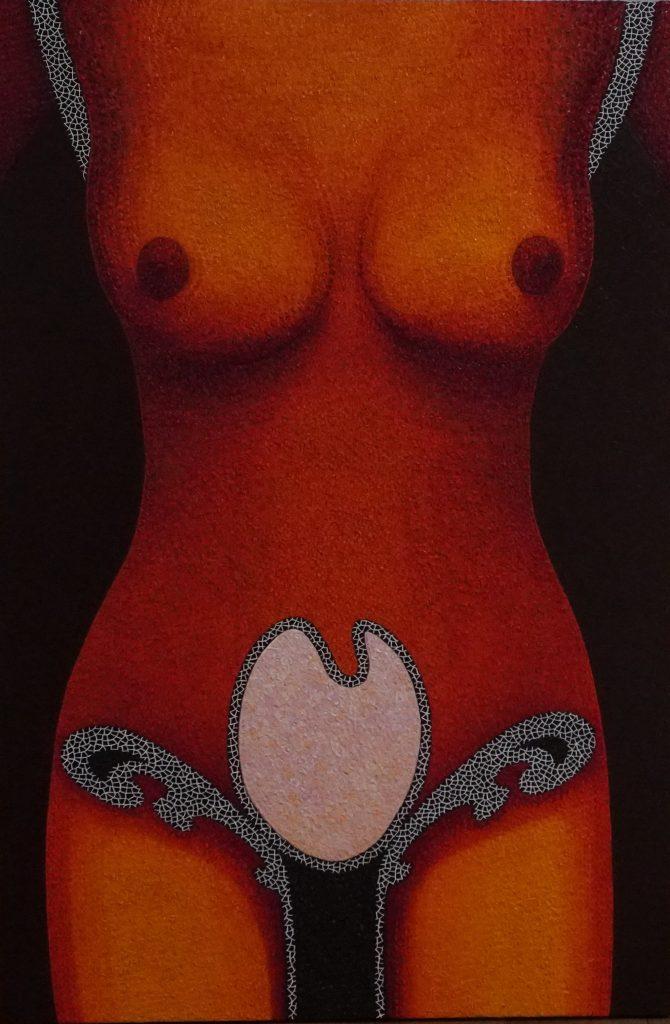
“Jungfrau / Virgo” places the female torso at the center of a symbolic meditation on fertility and identity. A flower-like form appears over the lower abdomen. Its shape recalls both a blossom and a stylized uterus, surrounded by intricate black-and-white ornamentation.
This central form is a symbol of fertility, creation and the life-giving potential of the female body. The surrounding orange and red tones communicate warmth, vitality and sensuality. Yet the painting should not be reduced to an image of motherhood. The reproductive symbol belongs to the woman herself. It becomes an emblem of bodily knowledge and personal identity rather than a role imposed upon her from outside.
Sensuality and Transformation
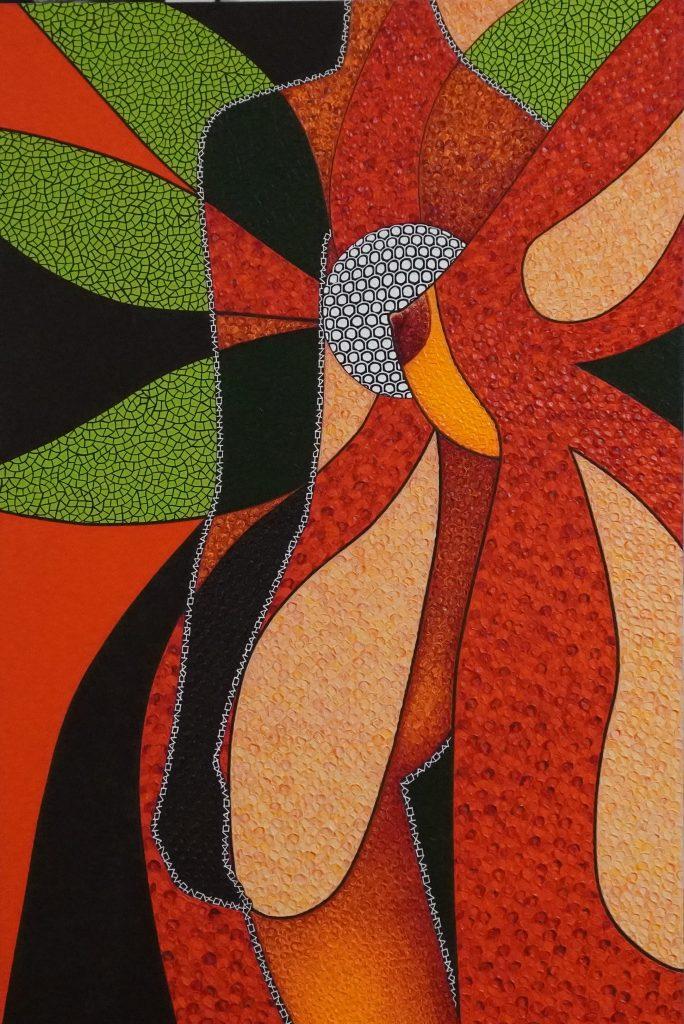
In “The Allure of the Sensual”, created in 2024, recognizable anatomy begins to dissolve into a field of interwoven red, green, orange, cream and black forms. Sensuality is expressed less through the image of a complete nude figure than through the movement between shapes. Curves approach one another, overlap and separate, producing a visual rhythm of attraction, contact and withdrawal.
The work suggests that sensual experience cannot be contained within a single body part or fixed image. It exists through relationships between forms, colors, textures and spaces. The body remains present, but it has become an atmosphere rather than a clearly bounded figure.
The Labyrinth as an Interpretive Key
The bilingual German-English publication “Olena Linse – Labyrinth” was published by Pashmin Art Publisher (2025) and edited by Nour Nouri and Dr. Davood Khazaie. It contains texts by Dr. Sohrab Tavousi, Dr. Davood Khazaie and Dr. Peter Schutt. The volume approaches Linse’s work through three interconnected areas: mythology, feminism and the philosophical and political meanings of the body.
Its title describes both the appearance and the conceptual structure of Linse’s art. Formally, the labyrinth can be found in repeated dots, interlocking contours, divided surfaces and ornamental pathways that guide the eye through each composition. Psychologically, it represents the complex routes through which identity, sexuality, vulnerability and self-knowledge are formed.
The works selected for the Greiz exhibition can therefore be understood as stages of an interconnected journey. “Luna” presents the body as a spiritual and emotional landscape. “Blickfang / Eye-Catcher” and “Liebe mit sich Selbst / Self-Love” examine the movement from external observation toward inward recognition. “Jungfrau / Virgo” reclaims fertility and bodily form as a source of autonomy. “The Allure of the Sensual” leads the body into abstraction, sensual energy and psychological transformation.
Together, these paintings demonstrate that Linse’s female figures are not passive objects. They look, feel, affirm themselves and change. The body becomes a language through which the artist presents womanhood as a living, evolving and self-defined experience.
© The copyright of the text belongs to Dr. Davood Khazaie
Find out more at https://www.olenalinse.com/