Origins: Displacement and Identity
Transformation is central to Andreas Schmidt’s artistic practice. Working mainly with discarded vinyl records, he explores memory, migration, perception, renewal, and the possibility of giving new meaning to overlooked materials. Although his work is associated with sustainability and technical innovation, its deeper source is a life shaped by displacement and cultural hybridity.
Born in Kazakhstan in 1980 into a family of ethnic German descent, Schmidt inherited a history of forced migration. His ancestors belonged to German communities that had settled in Volga German Autonomous Soviet Socialist Republic before being deported to Kazakhstan under Stalin in the 1940s. Their experiences of relocation and uncertainty became part of the family’s collective memory and influenced Schmidt’s understanding of identity and belonging.
At six, he moved from Kazakhstan to Russia, and at eleven he relocated to Germany. Although Germany was presented as a return to his ancestral homeland, it did not bring an immediate sense of belonging. Schmidt instead found himself between cultures. Art became a space where he could transform these tensions into creative energy, freedom, and self-discovery.
Discovering Vinyl as a Medium
Before dedicating himself fully to art, Schmidt financed his studies by buying and selling large vinyl collections internationally. This taught him to see records not only as carriers of music, but also as objects filled with cultural history, memory, and emotional attachment.
He also saw how easily damaged, outdated, or unwanted records were discarded. This contradiction fascinated him. Vinyl could preserve sound for decades, yet it was often treated as waste once it lost its practical value.
Schmidt began asking whether these objects could become something new. The material resonated with his experiences of migration and reinvention. Like people uprooted by changing circumstances, records could acquire a new identity without losing traces of their past. Their grooves, labels, scratches, and former purpose remained visible in the finished work.
Mastering an Unforgiving Material
Working with vinyl proved technically demanding. As a thermoplastic, it reacts sensitively to pressure, heat, and friction. Too much force can crack it, while cutting too quickly can make it melt.
Schmidt began experimenting around 2011, intensifying his investigations after 2017. With few established methods to follow, he developed his techniques through trial and error. One of his main tools became the fretsaw, a fine saw traditionally used for detailed woodworking. Its blade, only about one millimeter thick, allows intricate cuts, but using it on vinyl demands exceptional control.
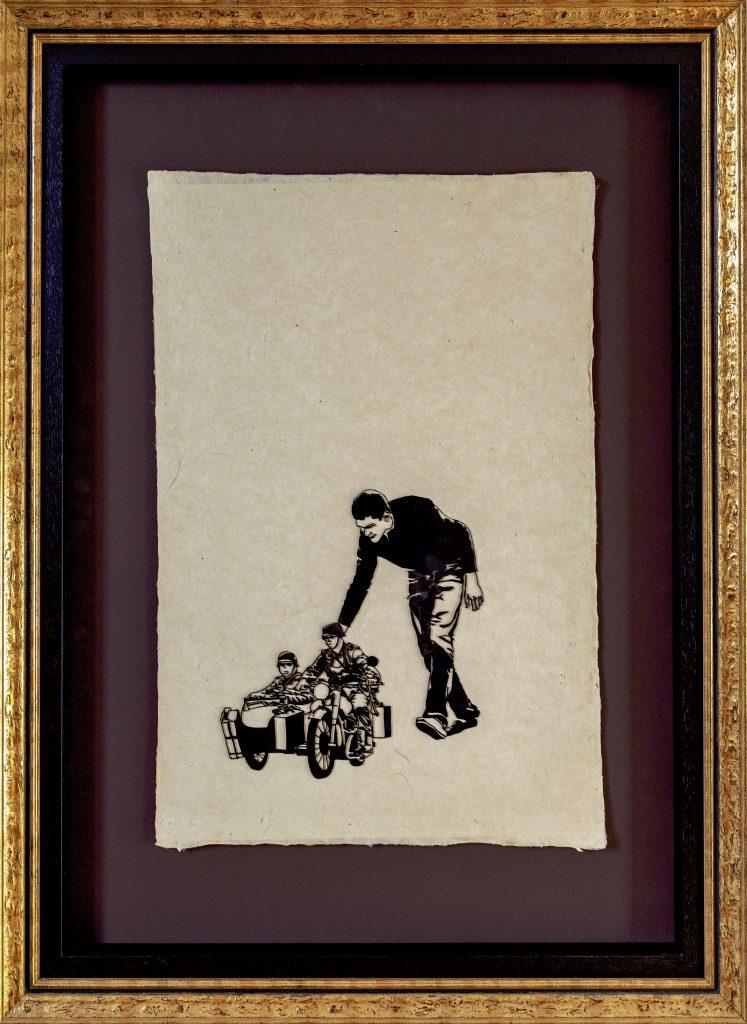
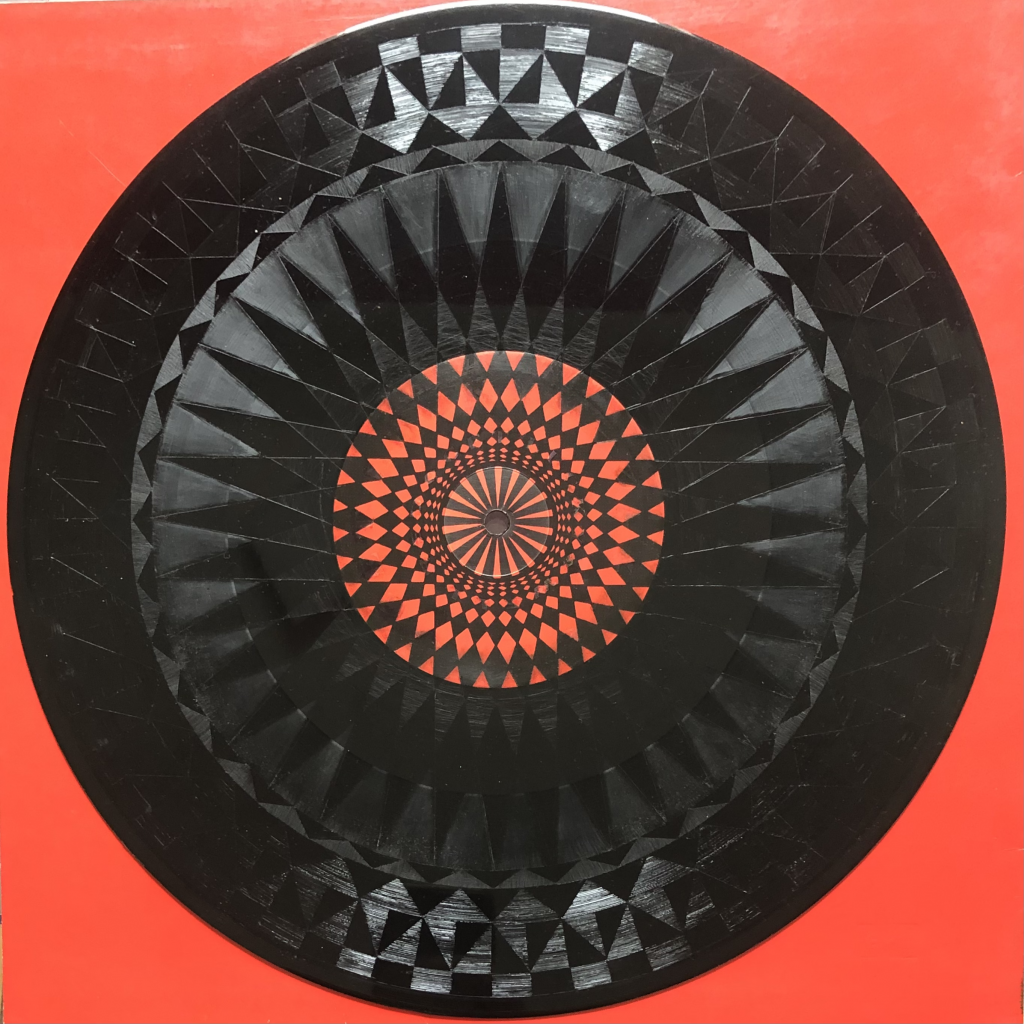
Over time, Schmidt learned to regulate pressure, speed, and temperature with precision. He now creates delicate cuttings in the centers of seven-inch and twelve-inch records, as well as refined one-line drawings directly in their surfaces.
The records are not merely recycled; they are transformed through a labor-intensive process combining craftsmanship, patience, and invention. Their limitations become part of the creative dialogue, requiring Schmidt to work with the material rather than dominate it.
Three Approaches to Transformation
Schmidt’s practice has developed into three connected approaches. The first is hand-cut vinyl, the foundation of his artistic language, emphasizing precision, intimacy, and direct contact with the material.
The second is collage, combining record sleeves, paper, printed images, and fragments associated with music culture. By rearranging familiar materials, he creates new visual narratives from objects that once served another purpose.
The third uses CNC technology to produce large-scale geometric compositions. A single record is limited to roughly thirty centimeters in diameter, but digital production allows him to connect many elements and build monumental installations.
I Spy with My Little Eye, exhibited in Beijing, demonstrates this expanded scale. Constructed from interlocking rhombuses, it first appears as a simple black geometric form. From closer viewpoints, white areas behind the structure emerge, creating depth, movement, and shifting optical effects. Its appearance changes with distance, angle, light, and attention.
This participatory quality is central to Schmidt’s geometric works. The artwork is not a fixed image but an experience that unfolds through observation.
Perception, Philosophy, and Haben und Sein
One of Schmidt’s most significant works is Haben und Sein, or To Have and To Be. This two-part composition brings together many philosophical questions found throughout his practice.
The first panel, Haben, consists of colored rhombuses cut from vinyl. Red, yellow, blue, and black-and-white elements represent different human temperaments and forms of behavior. The second panel, Sein, reorganizes these colors into a dynamic field that creates optical movement and challenges perception.
For Schmidt, “having” and “being” represent contrasting approaches to life. Having is connected with accumulation, possession, and desire for what is absent. Being develops through self-realization, awareness, and acceptance of complexity. It recognizes that reality can be understood from many perspectives rather than reduced to one interpretation.
The work can be installed in different orientations, reinforcing the idea that meaning depends on viewpoint. Even the original grooves are redirected to create new visual currents. The rhombus, formed from two triangles, resembles a navigational shape, suggesting direction, choice, and movement. These associations connect the work to Schmidt’s themes of migration, identity, and transformation.
Language, Culture, and Visual Thinking
Language and intercultural exchange have strongly influenced Schmidt’s outlook. As a young man, he pursued a Bachelor of Arts, including Mandarin Chinese as one of his subjects. The visual nature of Chinese characters changed his understanding of communication, showing how language can operate through image, metaphor, and association.
This strengthened his belief that visual art can cross linguistic boundaries. Schmidt speaks German, English, Russian, and Chinese, and his multilingual background supports a philosophy of openness and curiosity. Rather than limiting himself to one style, he works across drawing, sculpture, collage, installation, and digital production.
Play is also important. It appears in geometric series titled after childhood games and in his willingness to test unfamiliar methods. For Schmidt, creativity depends on discovery rather than repetition.
Sustainability Beyond Recycling
Although Schmidt’s use of discarded records connects his work to sustainability, his concerns extend beyond recycling. His art challenges the culture of disposability that defines much of consumer society. By transforming obsolete vinyl into lasting artworks, he questions conventional ideas of usefulness and value.
This principle extends to other materials. In Weathering, he combines vinyl with driftwood and found objects, creating a dialogue between industrial production and natural processes. In other works, he pours acrylic paint onto vinyl. Because the plastic surface is non-porous, the paint behaves unpredictably and requires careful control.
For Schmidt, this resistance is productive. Material difficulties generate new ideas and solutions. Sustainability therefore becomes more than an ethical position; it acts as a catalyst for innovation.
Action, Resignation, and Transformation
Schmidt summarizes his philosophy through three concepts: Action, Resignation, and Transformation. Action is the decision to create—to engage with materials, confront obstacles, and produce something new. Resignation means accepting uncertainty and giving up the illusion of complete control. Vinyl reinforces this lesson because its physical properties cannot be ignored.
Transformation emerges from the meeting of these forces. Discarded objects become artworks, technical problems become creative opportunities, and personal histories become sources of meaning. Records move from sound to image; displacement becomes a meditation on identity; waste becomes beauty; limitation becomes possibility.
Ultimately, vinyl is more than Schmidt’s chosen medium. It is a metaphor for resilience. Scratched, damaged, and forgotten records receive a new life, just as individuals reshape themselves through experience and change. In a world defined by consumption, mobility, and fragmentation, Schmidt’s work invites us to reconsider what has been discarded and recognize the creative potential within materials and ourselves.
© The copyright of the text belongs to Dr. Davood Khazaie