Lisa Etterich is a German painter whose work moves freely between abstraction, landscape, material experimentation and spiritual reflection. Born in Dülmen, where she continues to live and work, she studied design at the “Münster University of Applied Sciences” (Fachhochschule Münster) from 1971 to 1974. She subsequently pursued art studies through the “Hamburg School of Art” (Kunstschule Hamburg) and the “Zurich School of Art” (Kunstschule Zürich), before attending the “Institute of Fine Arts in Bochum” (Institut für bildende Kunst Bochum) from 1995 to 1998. There she studied under Professor Dr Yang, whose teaching introduced her to drawing, ink painting, attentive observation and the meditative traditions associated with East Asian art.
Etterich’s career has developed through regional exhibitions, international art events and a sustained collaboration with “Pashmin Art”. Among the earlier internationally documented appearances is the 2015 group exhibition “Pro Biennale” in Venice, where her works were presented in a project associated with “Milano Art Gallery”. The accompanying press emphasized the layered materiality of her painting, its relationship to memory and its movement toward metaphysical abstraction.
A particularly significant presentation took place in 2016, when her works were included in the Pashmin Art project “It Is All About Art—When Art Becomes Science” (It is all about art – Wenn Kunst zur Wissenschaft wird) at the “Hamburg University of Technology” (Technische Universität Hamburg). The exhibition brought international artists into dialogue with science, technology, mythology, geography, politics and the natural world. Etterich’s paintings were especially appropriate to this setting because their surfaces often resemble aerial maps, geological formations, atmospheric systems or visions of matter in transformation.
Her relationship with Pashmin Art continued through several well-documented exhibitions. In 2021 she participated in the virtual Hamburg exhibition “Figuratum through Abstractum I” (Figuratum durch Abstractum I), which examined the continuing possibilities of abstraction. In February 2022 her work appeared in the “Valentine Exhibition” at “Pashmin Art Gallery” in Hamburg. In 2023 she was one of four artists presented in “Metaphysical Mosaics: Dreamscapes, Realities and Beyond” (Metaphysische Mosaike: Traumlandschaften, Realitäten und Darüber Hinaus) at the gallery’s Bad Tölz location. That exhibition explicitly connected her art with dreamlike surrealism, cosmic harmony and the movement between tangible and immaterial realities.
In 2024 Etterich also participated in the Pashmin Art Consortia project “EuroVistas in Weiz: A Journey through European and Asian Contemporary Art” (EuroVistas in Weiz: Eine Reise durch europäische und asiatische zeitgenössische Kunst) at the “Weiz Art House” (Kunsthaus Weiz) in Austria. The wider exhibition tour connected institutions in Austria, Beijing and Chongqing, placing her work within an intercultural dialogue between European and Asian contemporary art. Pashmin Art Publisher has additionally devoted the trilingual monograph “Lisa Etterich: A Journey into Neverland” to her life and work, with sections addressing the relationship between matter and spirituality and the survival of mythological memory within contemporary painting.
Style: Matter as a Gateway to the Imaginary
Etterich deliberately avoids committing herself to one narrowly defined artistic direction. She works in watercolor, pastel, acrylic and oil, while also employing collage and mixed media. Her paintings are built physically as well as visually. She applies, pours, sprays, presses and scrapes pigments; uses brushes, palette knives and spray cans; and incorporates folds, plates and textured materials. Ridges, cracks and accumulations transform the canvas into an almost geological surface.
Her imagery develops intuitively. One gesture leads to another until shapes resembling cities, caverns, bodies of water, mountains or celestial structures emerge from the material. The result is neither completely abstract nor conventionally representational. Recognizable forms remain suspended within an unstable world in which scale constantly changes. A cluster may resemble a mineral formation when seen closely, an architectural ruin from a middle distance, and an entire city when imagined from above.
For Etterich, painting is also a form of inward observation. She has described pictures as mirrors of the soul and as challenges that create an active experience of seeing. Her works therefore do not present fantasy as an escape from reality. Instead, they use fantasy to reveal psychological and spiritual dimensions already present within reality.
This approach acquires particular meaning at the “Museums of the Castle and Residential City of Greiz” (Museen der Schloss- und Residenzstadt Greiz). The museums occupy the historic “Upper Castle” (Oberes Schloss) and “Lower Castle” (Unteres Schloss), an architectural ensemble containing elements from the Romanesque period to Art Nouveau. Etterich’s imagined castles, chambers, grottoes and distant settlements will consequently enter into dialogue with real spaces shaped by centuries of residence, memory and transformation.
The Works for Greiz
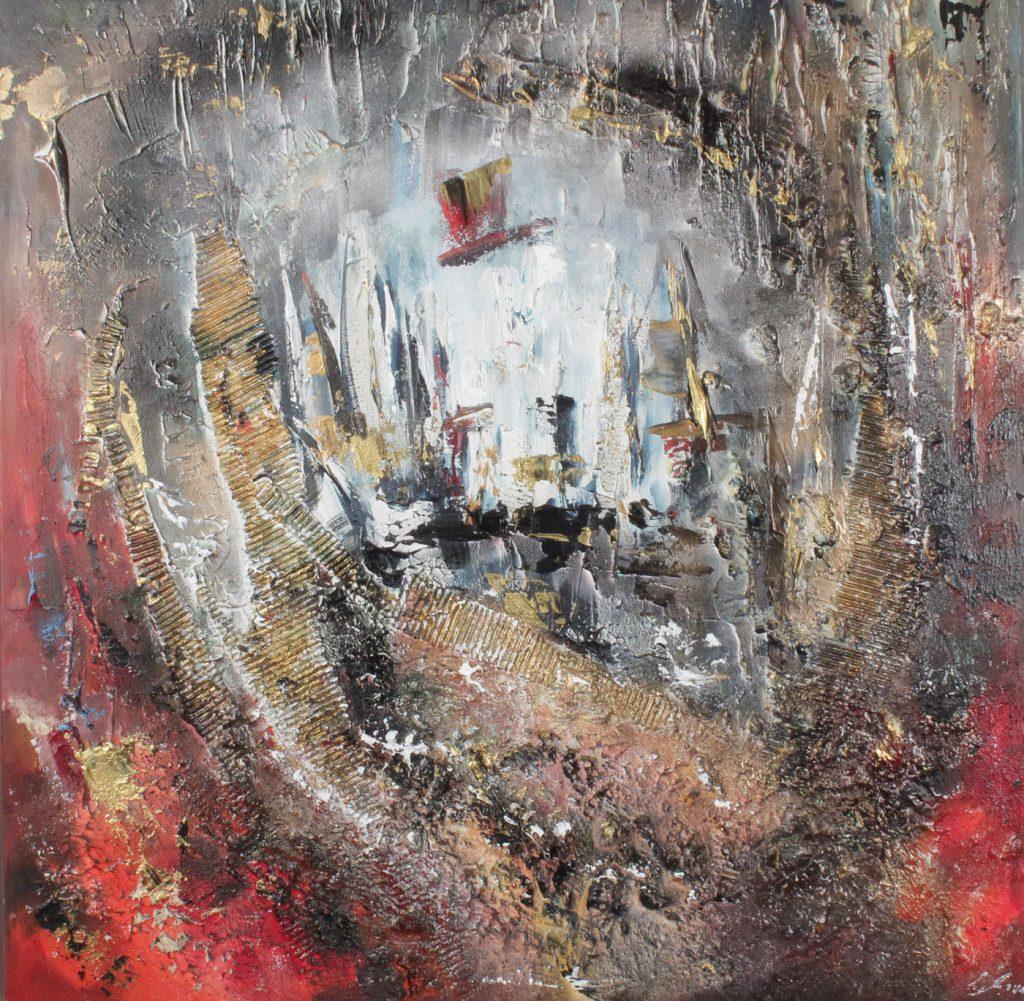
The exhibition begins conceptually with “Glowing Icy Grotto I” (Glühende eisige Grotte 1), a square mixed-media painting from 2014. Its paradoxical title combines burning heat with frozen stillness. A pale central area appears enclosed by darker mineral matter, while red passages flare around the lower edges. The image can be read as a cave, crater, eye or architectural chamber. Red suggests subterranean energy and creation; white and gray evoke silence, ice and suspended time. Opposing forces occupy the same pictorial body.
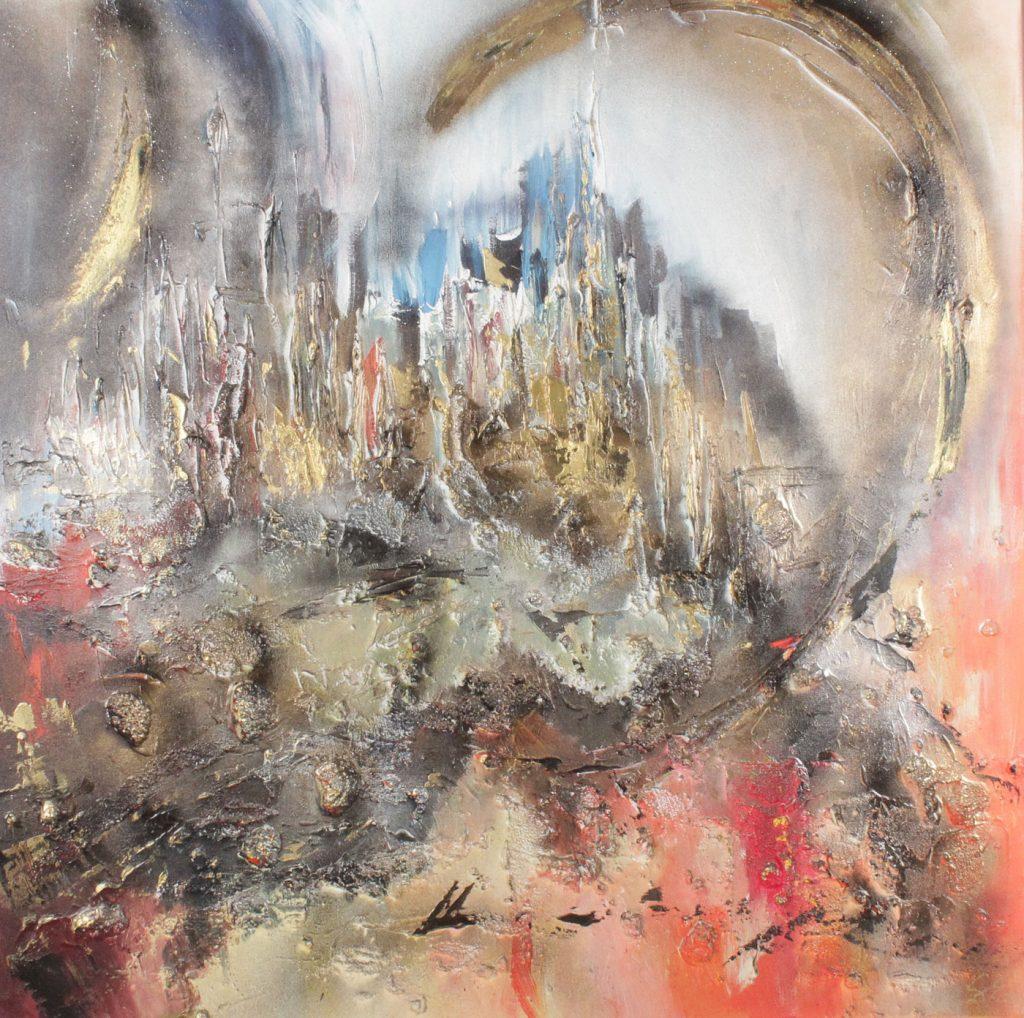
In “The Glorification of the Grotto” (Die Grottenverherrlichung), 2015, the cavern becomes brighter and more ceremonial. Vertical formations rise at the center like crystals, towers or a city uncovered beneath layers of earth. A broad arc encloses them like a vault or halo. The title transforms the grotto from a natural cavity into an exalted space—a sanctuary formed not by human construction but by matter itself.
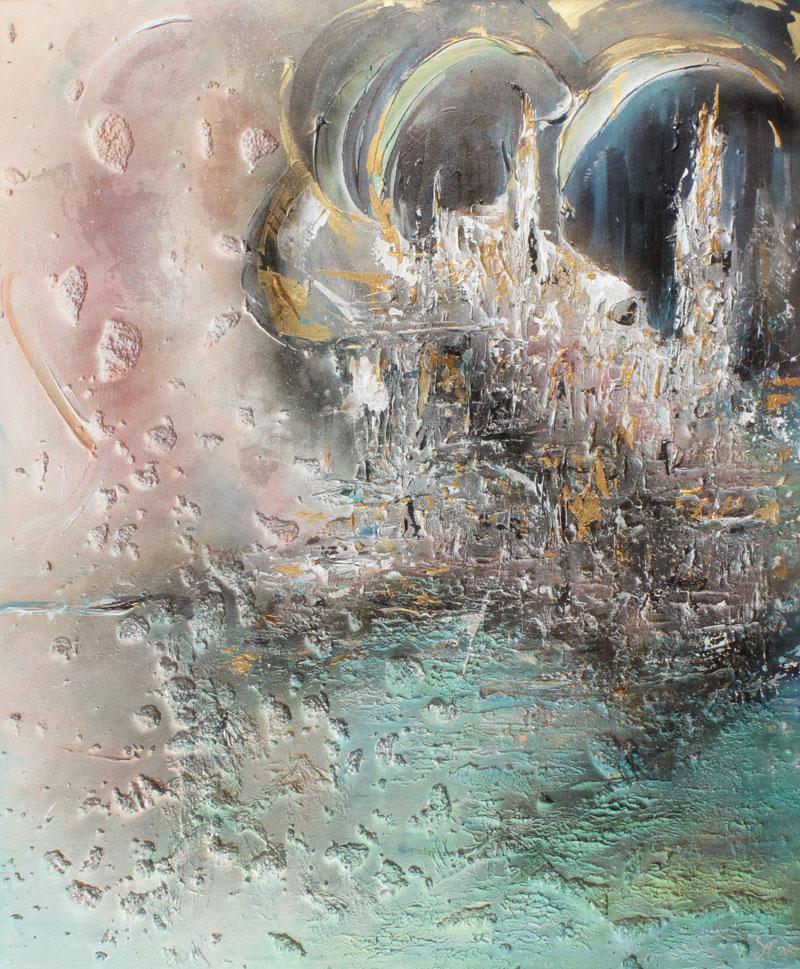
“The Mystical Castle” (Das mystische Schloss) and “The Sacred Castle” (Das sakrale Schloss), both from 2013, approach architecture as vision rather than documentation. In “The Mystical Castle” (Das mystische Schloss), pale rose, white and turquoise create an atmosphere of mist and reflected light. Arches and towers seem to condense briefly out of the surrounding air. The castle is fragile and distant, perpetually on the verge of disappearing.
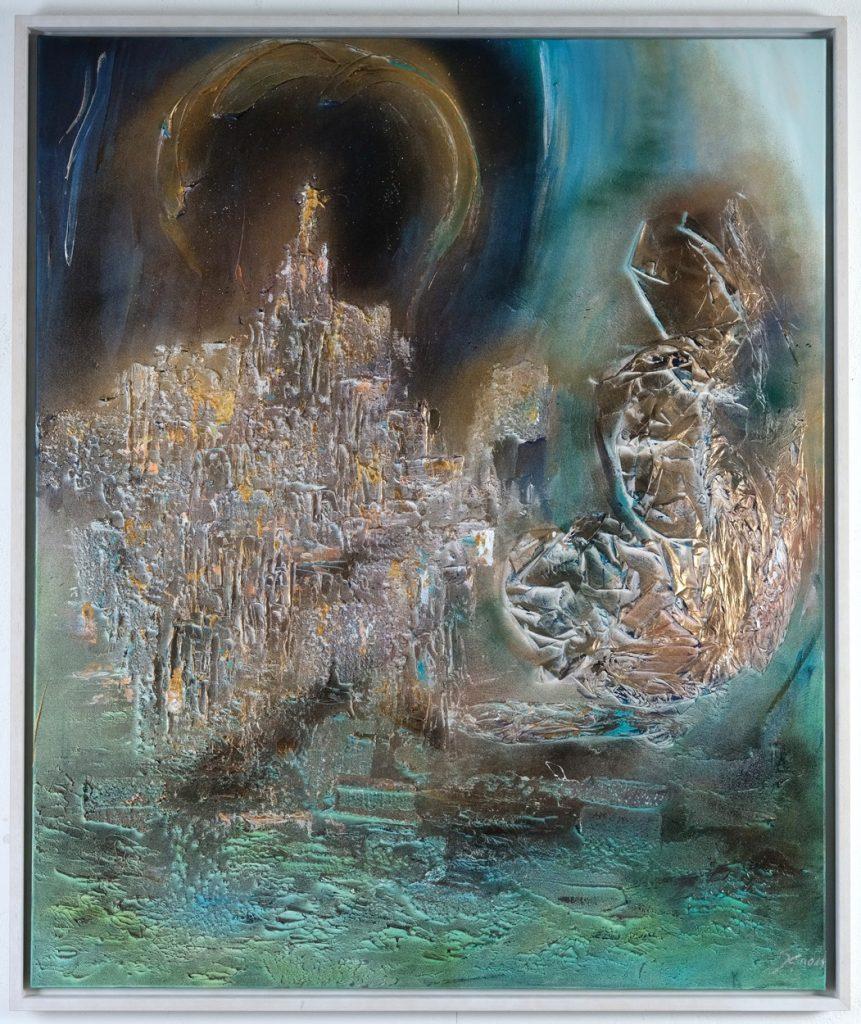
“The Sacred Castle” (Das sakrale Schloss) is darker and more solemn. Brown-black arches rise above a deep turquoise zone, while golden-gray structures gather between them. The sacred quality does not depend upon recognizable religious symbols. It arises through enclosure, vertical movement and concentrated light. The painting suggests a sanctuary, reliquary or protected city whose meaning cannot be reduced to a single narrative.
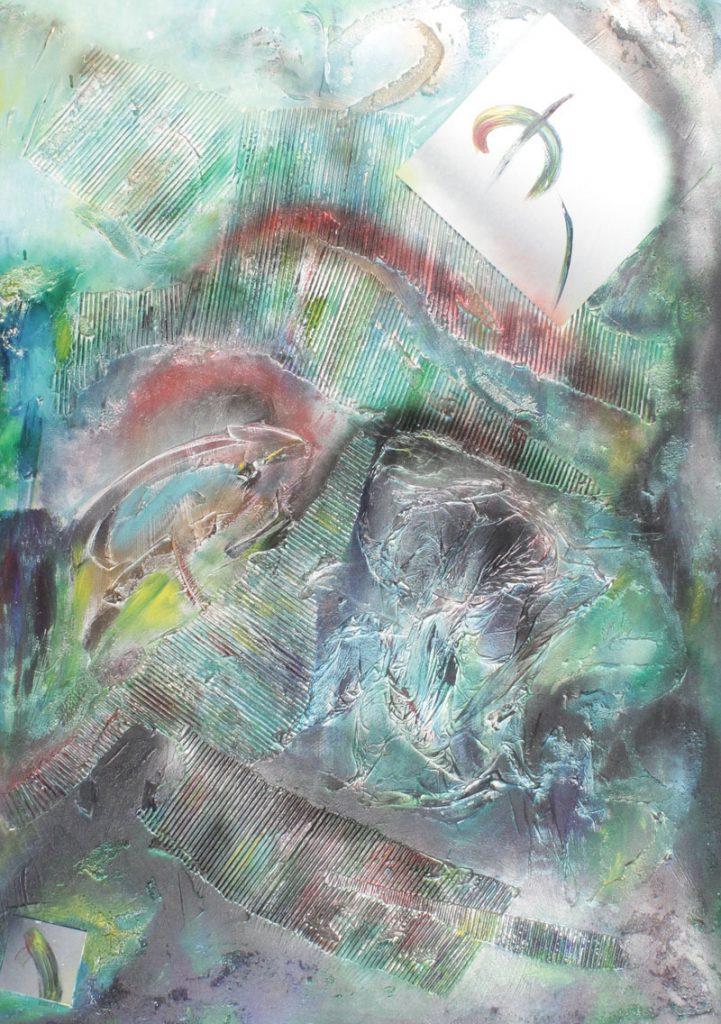
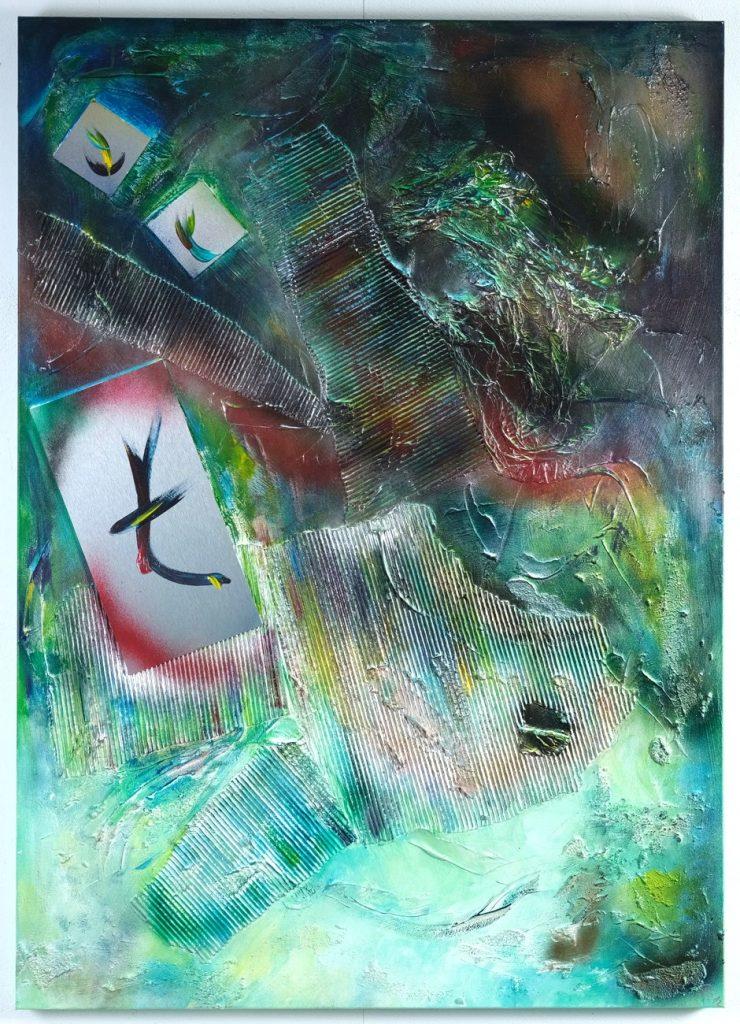
The paired paintings “Underwater World I (Left)” (Unterwasser Welt 1 (links)) and “Underwater World II (Right)” (Unterwasser Welt 2 (rechts)), created in 2012, form a passage between illumination and depth. The first is animated by pale turquoise, pink, white and green currents. Its shapes resemble marine organisms, vegetation and light refracted through moving water. The second descends into darker blues, greens and blacks. Rectangular fragments and calligraphic signs appear to drift within it like remnants of architecture or a submerged language. Together, the works show water not only as a subject but as a mode of perception: it bends light, dissolves boundaries and makes every form provisional.
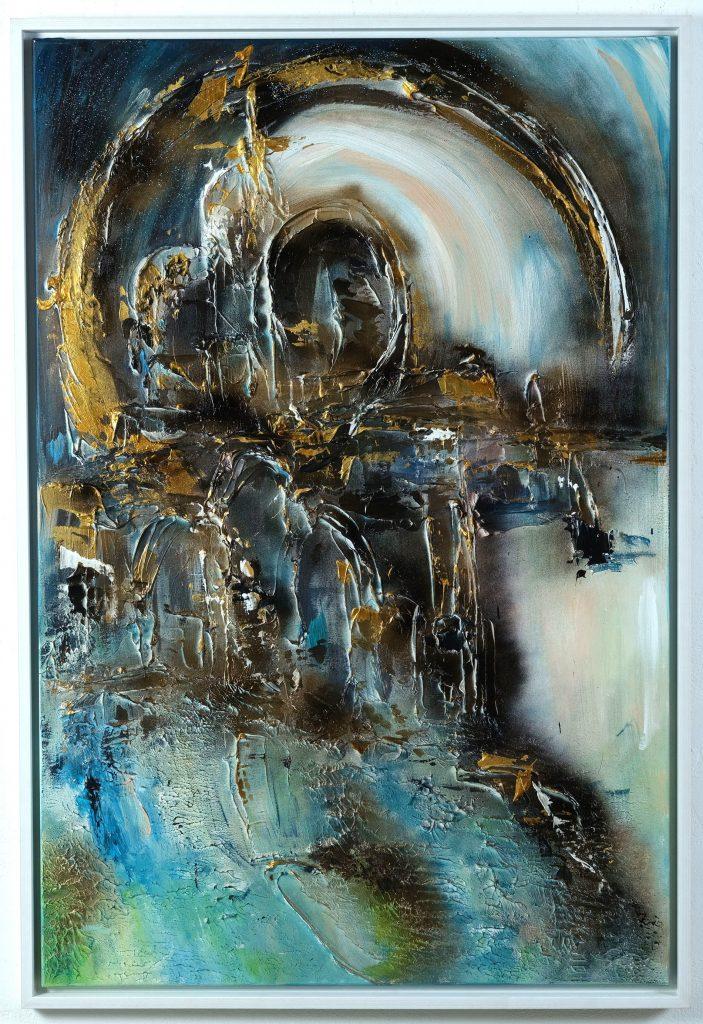
“In the Shelter of the Chambers” (Im Schutz der Gemächer), 2015, returns to the idea of an enclosed interior. A dark arch surrounds dense accumulations of black, brown and gold, while blue-green passages move through the lower field. The chambers promise protection, but they are not sealed. Light, water and darkness continue to pass through them. Shelter becomes a temporary condition in which memory and vulnerable forms may survive.
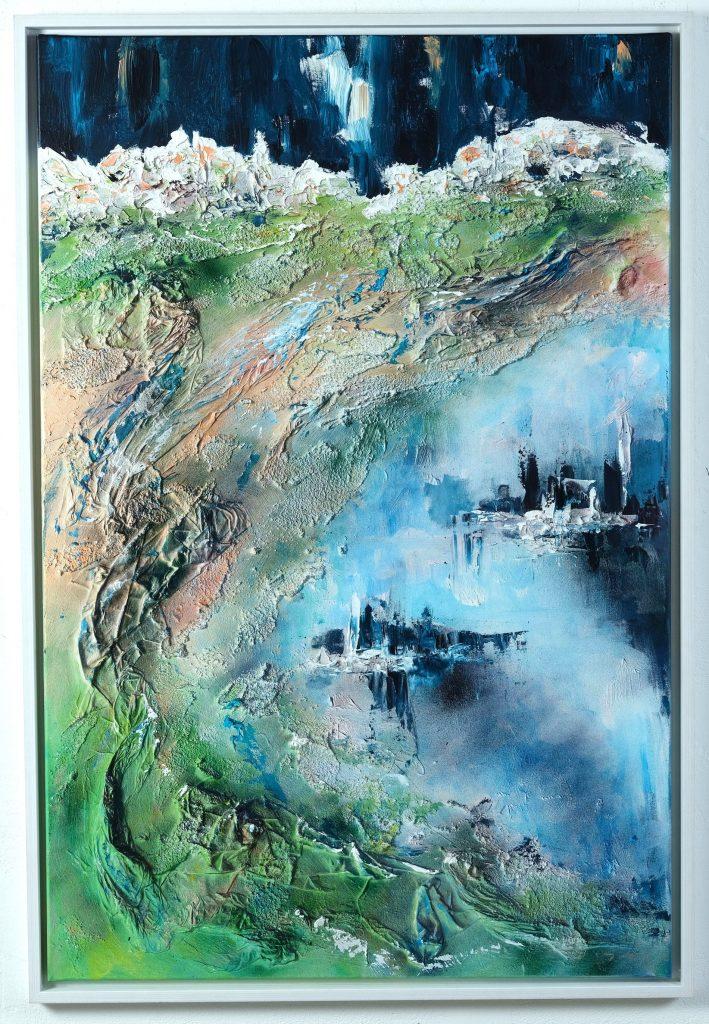
The sequence culminates in “Outlook” (Ausblick), 2015. After the grottoes, castles, underwater regions and sheltered rooms, the viewer is finally directed toward an open horizon. A pale ridge overlooks an expanse of blue containing distant formations that might be islands, boats, buildings or fragments of another city. Yet the painting does not offer a final destination. The observer remains at a threshold, looking outward from an elevated but uncertain position.
Together, these eight works form an inward and outward journey. Etterich’s grottoes are geological as well as psychological; her castles belong equally to architecture, memory and revelation; her underwater worlds preserve submerged traces; and her chambers protect the fragile inner space from which a new horizon becomes visible. In her art, reality becomes most compelling at the moment when its boundaries begin to dissolve.
See her at the “Museums of the Castle and Residential City of Greiz” (Museen der Schloss- und Residenzstadt Greiz), 3 October–22 November 2026
Dr. Davood Khazaie
(Literary Art Critic and International Curator)
© The copyright of the text belongs to Dr. Davood Khazaie
Find out more at Lisa Etterich’s website